
Are you looking for a wide-angle lens to navigate your week, or do you need a microscope to manage the hour-by-hour demands of a high-stakes role? To lead your life effectively, you have to choose the tool that matches your pace. Let’s walk through the real-world differences in how these formats shape your productivity.
The Weekly Planner: The Architect’s View
A weekly planner is designed for the person who manages “competing priorities.” If your life involves juggling multiple projects, family schedules, and long-term goals simultaneously, the two-page-per-week layout is your dashboard. It allows you to see the landscape of your week before it happens.
The strength of the weekly format lies in rhythm. When you can see Thursday while it’s still Monday, you can balance your energy. You’ll notice that if Wednesday is heavy on meetings, Thursday needs to be reserved for deep work. It prevents the “tunnel vision” that leads to burnout.
This style is best suited for:
- Executives and Managers: Those who need to see how meetings on Tuesday impact deadlines on Friday.
- The “Big Picture” Planner: Individuals who feel restricted by a single-day view and prefer to plan in “waves” of activity.
- Minimalists: Those who want a slimmer, more portable planner that focuses on key milestones rather than granular hourly tracking.
The Daily Planner: The High-Performance Engine
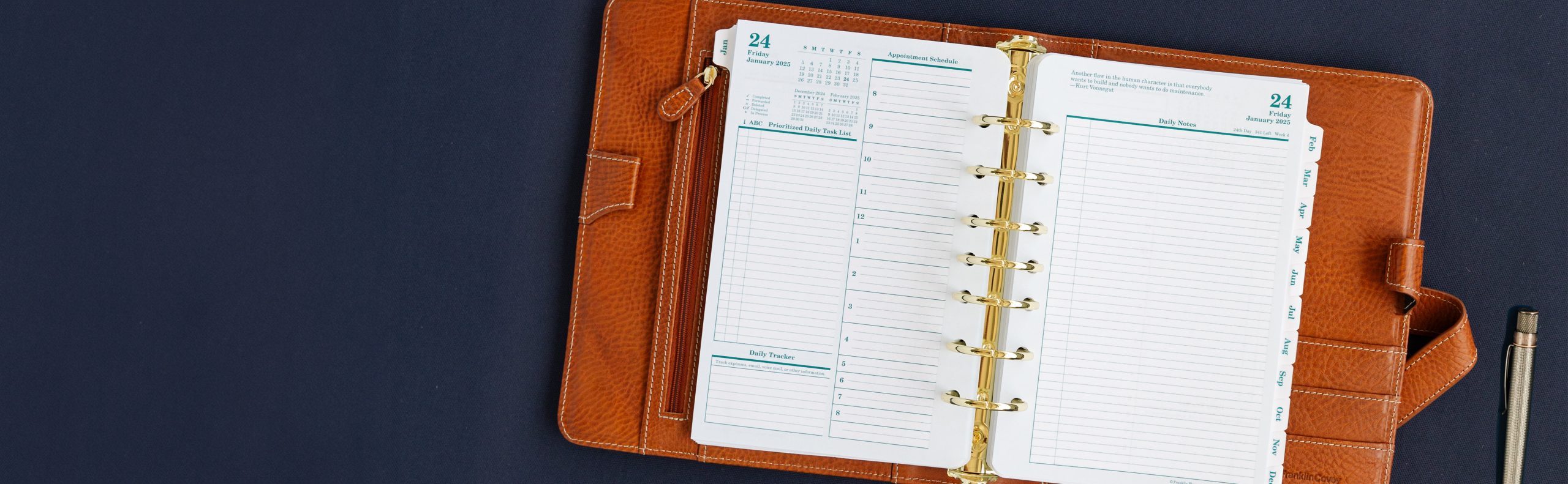
In contrast, the daily planner, specifically our signature two-page-per-day system, is built for intensity and accountability. This is for the individual whose day is a series of critical tasks, appointments, and rapid-fire decisions.
When you use a daily planner, you aren’t just glancing at a schedule; you are documenting a journey. With a full page dedicated to your Prioritized Daily Task List and appointments, and a second page for “Notes and Thoughts,” you have a dedicated space to capture the brilliance that happens between meetings. It eliminates the “scatter” of Post-it notes and digital scraps.
This style is best suited for:
- High-Output Professionals: Entrepreneurs or individuals in roles where every hour is accounted for, and details cannot be missed.
- Goal-Seekers: Those who use the Franklin Planner system to break down major life goals into small, manageable daily wins.
- The “Capturer”: If you find yourself taking constant notes during calls or needing a place for daily reflections and journaling, the daily format is non-negotiable.
Making the Decision: What Matters Most?
At Franklin Planner, we believe that planning is about more than just checking off a to-do list; it’s about goal-reaching and intentional living.
If you find yourself feeling overwhelmed by the sheer volume of “stuff” and need a way to focus only on the next 24 hours, the Daily Planner is your anchor. It provides the structure to help you focus on what matters most today.
However, if you feel like you’re constantly “fighting fires” because you didn’t see a deadline coming, the Weekly Planner will give you the foresight needed to regain control of your schedule. Ready to take control of your time? Discover the structure that fits your life by browsing our Daily Planners for total task-level control, or explore our Weekly Planners for a high-level view of your success.


2 Responses
Looking for 2 page monthly planner. Classic 2 montecello
Interesting way to differentiate the two methods of planning. I’ve been using the 2PPD format since 1997. For the last 10 years I’ve augmented it with 2PPW pages for the reasons you mention.
My planner is the 2PPD with the monthly, daily, and tabs.
I then insert the weekly pages for the current month into its own tabbed section. Here is where I do my time blocking for the week, including travel time. This helps me schedule in phone calls and audio teams calls during travel time enabling increased efficiency.