Are you ready to discover the keys to greater productivity and lead your life and team with principles that stand the test of time? Welcome to The Franklin Planner Podcast, your weekly guide to achieving your best life through proven strategies, timeless values, and expert insights. Whether you’re looking for ways to boost your personal productivity, lead your team to new heights, or find lasting success, this podcast is your trusted companion on the path to intentional living.
For more than 40 years, Franklin Planner has helped millions infuse their lives with meaning and clarity. Inspired by the principles of Dr. Stephen R. Covey and his groundbreaking work, The 7 Habits of Highly Effective People, this podcast builds on that enduring legacy. Hosted by Franklin Planner Board Member and Owner John Harding, alongside industry expert George Wright III, each episode dives deep into the essential habits, disciplines, and leadership principles that transform both individuals and teams.
Together, John and George bring decades of experience, combined with interviews from accomplished business leaders, productivity experts, and success coaches, offering valuable lessons you can apply today. From overcoming roadblocks and staying focused on the “Big Rocks” in your life to fostering collaboration and trust in your team, the discussions are rich with actionable takeaways and practical wisdom.
The Franklin Planner Podcast is more than a tool for learning; it’s an invitation to a community committed to growth, purpose, and intentional living. If you’re ready to take charge of your time, lead with integrity, and craft a legacy of success, this is the podcast for you. Tune in weekly, and let’s unlock your full potential—one timeless principle at a time.
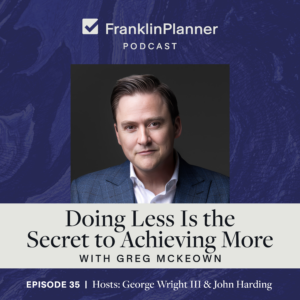
On this episode of the Franklin Planner Podcast, host George Wright III sits down with Greg McKeown, New York Times bestselling author of Essentialism and Effortless, to challenge everything we think we know about productivity and success. Greg shares why today’s technology leaves us feeling more overwhelmed than ever, how to take back control of our priorities, and why learning to understand others is essential to living a more intentional life.
00:00 Why Less Matters Now
03:31 Tech Built Wrong
07:11 Disorientation Machine
12:54 Why Priorities Fail
24:24 New Conversation Game
31:22 Effortless Versus Hard
33:29 The 10X Dilemma
40:34 Easy Not Lazy
48:18 Prioritizing With Others
Thank you for joining us on this Journey to create your best life and to lead your Life and Teams. Please share this show, and we look forward to the journey we will take together.
Check out the New Membership Program Here: https://store.franklinplanner.com/lps/membership/
The Franklin Planner Team
About Greg McKeown
Dr Greg McKeown and his wife, Anna, are the proud parents of four children. McKeown is the author of two New York Times bestsellers, “Essentialism: The Disciplined Pursuit of Less and “Effortless: Make It Easier to Do What Matters Most”, which together have sold 3 million copies and been published in 40 languages and recently released The Essentialism Planner, a 90-day guide to accomplishing more by doing less.
Links
Website: https://gregmckeown.com/
Books: https://gregmckeown.com/books/essentialism/
LinkedIn: https://www.linkedin.com/in/gregmckeown/

On this episode of the Franklin Planner Podcast, host George Wright III sits down with Greg McKeown, New York Times bestselling author of Essentialism and Effortless, to challenge everything we think we know about productivity and success. Greg shares why today’s technology leaves us feeling more overwhelmed than ever, how to take back control of our priorities, and why learning to understand others is essential to living a more intentional life.
Episode Timeline
00:00 – Welcome & Guest Introduction
01:34 – From Distraction to Disorientation in the AI Age
03:32 – The Flawed Assumptions Built Into Technology
07:11 – The $3 Trillion Disorienting Machine in Your Pocket
09:44 – What Is Essentialism?
11:00 – The Personal Wake-Up Call: Choosing Essential Over Non-Essential
13:18 – Why Interpersonal Essentialism Is Hard: Confident Misunderstanding
20:38 – The “What, So What, Now What” Daily Protocol
23:58 – Changing the Communication Game: Understanding vs. Persuading
29:08 – The Origins of Seek First to Understand
32:02 – Effortless: An Insecure Overachiever’s Guide
36:00 – The South Pole Expedition: Maximum Effort vs. Sweat Management
41:56 – The 85% Rule for Sustainable Success
43:58 – Paradigm Shifts Through Reflection & Engagement
45:48 – The Seagull Story: Uncovering Hidden Perspectives
51:10 – Free “Less But Better” Course & Closing Thoughts
Episode Transcript
George Wright III: All right, welcome back to the Franklin Planner Podcast. My name’s George Wright III. I am your host. I’m super excited to be with you here today. John Harding, our co-host, is not here, but as always, the Franklin Planner Podcast is here to help you, is basically bring you these timeless principles and insights to help you to lead your life and create the life that you were meant to live. And we have all kinds of new cool things coming out, but I don’t wanna waste any time because we have, as part of our special author spotlight, Greg McKeown here in the studio. Greg, how are you, sir?
Greg McKeown: Oh, it’s just a pleasure to be with you. Thank you.
George: Yeah, we’ve been excited to get together, and both of us in the same conversation, I think there’s gonna be some great value for our audience. So just so that I could give a bit of a framework setup for those of you listening, let me give you a little introduction.
So, Greg McKeown and his wife, Anna, are proud parents, four children. He’s the author of two New York Times best-selling books, Essentialism: The Disciplined Pursuit of Less, and Effortless. And Effortless, the book, Make It Easier to Do What Matters Most. And both of these have sold millions of copies and been published in forty languages. And so you just have an amazing framework that really dovetails into what we believe at Franklin Planner, and so, as I mentioned, I’m just super excited to have you here today.
But I wanna start with a core question. Greg, you’ve built your work around the idea that you can accomplish more by doing less, but why do you believe that message is more important today than ever before?
Technology and Disorientation
Greg: Well, even in the ten years since I published Essentialism, I think we’ve been through a sea change. At that time, we were well into the Information Age, and the primary unhelpful thing that grew out of that was distraction. And on the other hand, now, as we have moved into the AI age, primary output that we don’t want is disorientation. We’re not distracted anymore, we’re disoriented.
And that is…really is the sea change. I mean, that language sea change is important here because we feel a certain sensation. It’s not just information overload, it’s emotion overload. And it’s noise, if you had to give a single word to it. And if you go back into the roots of the word noise, it’s nausea. You know? What we are feeling is a seasickness, and what I think is at the heart of it is a disconnection between, “Well, where am I? Where do I want to be? How do I get there? What’s holding me back?”
The rise of short-form content
All of that orienting context and direction, it’s all being disrupted in our, you know, these video shorts. We’re seeing the world through video shorts, all disconnected to the next thing. And so people really do, I think, have a sense of “Where even am I?” Upside down. And we need something, I think, outside of technology to be able to help us orient again, back to what matters most.
George: In some of our pre-discussion, we talked about the idea that there’s this problem out there, and you’d think the initial problem is digital overwhelm, but it’s more than that, because as the digital world came into play—and Franklin Planner’s been around for so long, helping people to lead their life and focus on what matters most, the most important things, and you would think digital tools and technology would come along and help you to do that better—but the problem is that so many people are so busy and not productive. And why do you think that is? Why hasn’t technology helped us do more of what matters most?
What technology was really built for
Greg: Well, look, first of all, all technology is built upon assumptions, so we interact with it at the device level, at the application level. But below that, you have— eventually you get back to your data centers, and that’s often close to where the conversation ends if you’re working with technology companies. But of course, all of it is built upon assumptions underneath that, and if you build all of your technology on an assumption that is either wrong or just not optimal, then all of the tools and everything that we interact with will play out with that lens.
And so which lens do you think? Which lens do we feel was actually built? Was it a lens of…prioritization? Like, is that what all of these applications—email, to use, you know, the most basic example—was email built on the idea of prioritization? Through that lens, or productivity? But it’s so obvious, the answer. Because even now, right, twenty years into a world completely consumed with email, you still can’t prioritize your emails. Like, to this moment, you still can’t actually just look at all your emails and order them. Now, there’s a few different apps out there that try to do a little more, but the fundamental design did not even consider it.
A nefarious agenda
So that’s just an illustration of it. These tools, they’re not just neutral. They’re not just— well, you know, they make— I do believe that technology makes a good servant and a poor master. I think that’s true. But I actually think it’s more nefarious than that. There’s a stronger agenda than that. There are assumptions that are being built into them that really are not actually focused on helping us live the life we want to live, build the relationships we want to build. And so in a sense, you could say it this way, that technology has been built in the wrong paradigm for the actual kinds of lives and relationships we want to have. That, I think, is not a trivial part of what the problem is.
Working against creating an intentional life
George: Yeah, I’ve never thought about it that way, but you’re right. It’s built on the wrong assumptions, ’cause even personally, I would look at it and say technology is designed to help me do more, not more of what’s important. And it’s also, it’s designed to help me to set it and forget it, when I’m supposed to want to be more intentional in my life and focused on things that are important to me. Whereas the Google Calendar is designed to just say, put it in there and you don’t have to think about it, it’s gonna remind you when it’s time. And so all of those assumptions are working against creating an intentional life focused on what matters most.
Greg: Yes, and I think you can go further than that. Like the device in our pockets: whatever it is, it’s not a phone. Right? Like, that’s the last thing that it is. And I don’t even know that any of us really know even to this moment what it is. But a step in the right direction would be to say it’s a three-trillion-dollar, military-grade disorienting machine, where the owners of that technology are only getting paid when we’re disoriented. So that’s literally true.
Designed to keep us disoriented
So like, when you think about the social media feed, and why is it that every so often in your feed, there will be some really violent video from somebody you don’t follow? It’s like, “What— How is it even in here? What is this even—?” Well, because if you can keep your user in a state of alarm, in a state of threat, then you’ve got them. Because if it were true, for example, right now, if there was something in the studio where you have— somebody comes in violently, you know, heaven forbid— well, of course, we wouldn’t be having this conversation. Suddenly you would have to, for your own survival, focus on that threat. Well, that’s exactly what social media in our pockets has done, and it’s not a bug. It’s a feature. It is absolutely designed to keep us disoriented. So this is what we’re up against. This is the challenge.
George: And it’s interesting ’cause disoriented, distracted, you’re absolutely right because I do a lot of work in the marketing and authority world, and you can’t really read or go deep into topics and subjects anymore without the intention of advertising and pop-ups and things to distract you, because the number one goal of most media sources is to distract you to advertisers and income and things like that. So you’re right. I think this is so true, and I think it’s why most people struggle to accomplish more, because they have more working against them with distractions.
Essentialism: The Disciplined Pursuit of Less
So you wrote the book Essentialism, which is “the disciplined pursuit of less.” I love that. So tell our listeners what is the core philosophy, ’cause we’re talking about now: How do you fix this? And you’ve got this amazing book that talks about a core philosophy behind how we can apply focus in our life on what truly matters. So give us sort of the philosophy behind the book Essentialism.
Too much growth results in collapse
Greg: Yeah. So let’s just contrast it like this, that you’ve got the undisciplined pursuit of more, which is the norm of our times. You’ve got the path behind that is you— At some point, you, or in this case, our society, becomes focused and successful, and with that success, you get an enormous growth of options and opportunities. And all of that sounds like the right problem to have, but it does in fact turn out to be a problem. The undisciplined pursuit of more actually leads us to plateau in our life or even collapse altogether.
And I learned about this, in a way, the hard way. And I was working with Silicon Valley companies, and I was noticing that this pattern worked predictably there. But then I get an email from a colleague at the time, and it said, “Look, Friday between one and two would be a bad time for your wife to have a baby because I need you to be at this client meeting.” And I’m sure they were just joking.
Trading the essential for the nonessential
But still, when the day came, our daughter born in the early hours of Friday morning, and I was trying to do it all. I have my laptop open, my phone on. If I can do it all, I can have it all. And then to my shame, I do go to the meeting. And even afterwards, I remember my colleague saying, “Well, the client will respect you for the choice you just made.” But it’s obvious I made a fool’s bargain, that I violated something essential for something nonessential. That’s the undisciplined pursuit of more.
Essentialism is about prioritization, not productivity
What I learned in that experience is that if you don’t prioritize your life, someone else will. And that’s really the difference between the non-essentialist paradigm and the essentialist paradigm. The essentialist paradigm isn’t about productivity, it’s about prioritization. But it’s not just about prioritizing now and then. It’s about a way of looking at your life through that lens.
And the antidote to the problem is this disciplined pursuit of less. It’s a way of being, a way of thinking, and something ultimately we become. We don’t just do essentialism or think essentialism; we become an essentialist. And it seems to me that that’s the level of growth that’s necessary to meet the level of challenge that we have.
George: Yeah, and I think that most people, if they step back for a minute, they slow down for a minute, they’re gonna realize that is important. And I’m curious from your perspective, ’cause you’ve just been all over the world, you’ve had this message, and you’ve talked to a lot of people. Why do people find it so difficult to prioritize identifying the few things that are important? What have you found is the reason that people find it so difficult, other than the distractions that are pushing and working against them?
Greg: Well, I would answer that question differently now, based on the last ten years. Ten years, I’m asking almost the question you’re putting to me there. Why is it so hard? But if I just say it slightly differently, it’s “Why is it so hard to live this in a world of people?” Right, like in a world of relationships, on teams, hierarchical organizations? Right? Like essentialism would be easy if it weren’t for the people. [Laughter]
George: [Laughter] Right.
Greg: Right. So then that question, like “What’s the priority bottleneck to living essentialism with people?” And here are things it’s not: it’s not talent, it’s not execution, it’s not strategy, it’s not effort. Now of course, those things matter. But the priority bottleneck is something, really, that has surprised me. Rather than just answer it, let me just share a little piece of research that puts it into perspective, if you don’t mind.
Confident Misunderstanding
1990, Stanford student, PhD student, Elizabeth Newton runs a simple experiment. She brings together eighty people, divides them into two. One person is the tapper, one person the listener. The game is simple. The tapper will choose a song out of a list of twenty-five songs that everyone knows and will tap that song to the listener, who will guess it. That’s it. That’s the whole game.
But before they run the experiment, she asks the tappers, “What’s your confidence level that the listener will be able to guess successfully?” And the answer was, on average, 50 percent. They were 50 percent confident as a group. But in actual fact, as they ran the experiment, only 2.5 percent of the time were people successful. So that was 3 out of 120 trials.
Now, I’ve replicated it nonscientifically in multiple groups and found that because— She didn’t ask the listeners their confidence level, and the listeners have come back at the same level of confidence, and sometimes in some groups as high as 80 percent on average. So whenever you have a situation, the expectation is so different to reality, you know, if it’s 10 percent different, okay, fine. In this case, anything over 10X is significant. This is 20X difference in what people expect to what is happening.
“People don’t know they’re doing it”
Now, that turns out to be the very heart of it, and it’s very touching to me even to this moment, because it’s so surprising. But what the answer is, why people can’t do it in a world of people, is confident misunderstanding. And confident misunderstanding is such a beast of a problem, because the very nature of it, by definition, people don’t know they’re doing it. That’s the whole point. It’s confident misunderstanding. You think you’re understanding. In fact, you don’t even think you’re understanding; you just are dealing with reality, as far as you’re concerned.
And so this makes it so difficult to have shared clarity, shared understanding of a shared reality, so that you can then make shared trade-offs and have a unity around what really is essential and what is less essential, so which things you should give up for doing those other things. So in a sense, the individual work of prioritization is completely necessary and insufficient.
Other people are the key to understanding
One must start there; of course you need to have a point of view of your prioritization, of your life and what you think matters—and the other person, you want other people. It would be better if the whole world were doing that intentionally, proactively. But that would not get us to the point where you could actually live life out as an essentialist. You also have to upgrade your ability to talk about the most important things, and as it turns out, the more important the subject, the worse we show up. [Laughter]
George: Right. The more, the less, exactly.
Greg: Yeah, yeah. The less well we show up, the more challenging we’ll be to have the conversation. So essentialist conversations require higher ability to silence the noise, the emotional noise inside, and access the other person, and it’s like people simply do not have these skills. I have come to that conclusion over the last ten years and then spent five years doing a doctorate—mid-career doctorate—at the University of Cambridge (that’s a terrible idea; nobody should do a mid-career doctorate), going deep into it to try to understand, okay, what’s the level of the problem and what’s the simplest, clearest antidote, if we can find one? And that’s what I’ve been— that is what I’ve been focused on.
George: I love the perspective, because it’s problems that people sort of recognize, but confident misunderstanding is a great way to look at it, because I think people understand planning what matters most and also prioritization, and as you mentioned, it’s an important place to start. But when you add people and the world around you and actually application of that, everything sometimes goes out the window, and having those conversations, so it’s interesting, ’cause I was gonna ask you about two aspects.
Intentional Prioritization
One was how do we become more intentional about our priorities and setting prioritization? But the other is, when you start interacting with people, how do you learn to say no? How do you learn to not let other people’s agendas affect your priorities? Because you’re right: you can do as much priority setting as you want, and even there, I think people fall short. They don’t identify the priorities. But you then have to take those around the world around you, which involves people and not disappointing or damaging relationships, and things like this. So maybe you could speak to kind of both of those steps for us.
Reactivity prevents deep thought
Greg: Yes, if you are unclear about your own prioritization, if you haven’t thought about it, then you can’t do anything but be reactive with other people. And that, that reactivity, which is, it’s almost like we have a perfect reactive storm going on right now because that is what this—we call it social media, but really it’s sort of like this threat media—is doing to us. It keeps us in this reactive state. If you’re just always reacting and then you start to have a conversation with someone, you’re full of noise, you’re reacting to the first thing they’re saying, and whatever they are reacting to, “Oh, okay, well, I need to, uh, okay, they’re focused on this thing. I guess I’ll focus on that thing.” It’s like we’re all just, you know, pinging off of each other.
Take time to reflect
So yes, having a space before you reach for your phone to be able to… I mean, I like now the… call it the “so what, now what,” daily “power half an hour,” you know, write down what’s going on, get that noise in my head out on a page for six minutes, like a protocol. Six minutes, just free writing all the noise. So what? I’m saying, okay, what’s the news for me today? Therefore, what? If this is all what’s going on, let me try and connect the dots. Let me see what’s actually important to adjust to the conditions of my day. And then the “now what” is like a one, two, three method. I like the idea of one priority for the day. Singular. And then two things that are essential and urgent, and then three things that are maintenance items that if I don’t do them makes tomorrow a lot harder.
Okay, so that’s sort of a unit for what one can do to be able to take back some control of our life. If we don’t have ten minutes or even half an hour to think, it’s like we don’t even have a life. We have to try to negotiate and push back in such a way that we have some space to think. If you wanna focus, you’ve got to escape to focus. Well, that’s kind of the first part of the problem. That’s getting us into a position where we can begin to negotiate with the world around us, to act upon it rather than to be acted upon.
Effective Communication
But it’s not the end of it, because then the moment you interact with other people, well, maybe they’re reactive, they haven’t even thought through it, they’re full of noise, or there’s somebody that has determined to do something and that’s not at all what you’d identified yourself. And of course, we can’t simply go through life saying no to everyone and everything without really thinking about it. I’ve never advocated that we should, but sometimes I want to point out, you know, I didn’t write a book called No-ism. You know, I didn’t say, “Say no to everything and everyone.”
George: Right. Yeah.
We learn from our families
Greg: It’s essentialism, so it’s the negotiation around what is most important. And then once we move into that category, we literally have to develop skills that currently are invisible and missing, and therefore keeping us completely trapped. So most people learned almost all of their communication skills in their family. Well, okay, there’s nothing essentially wrong with that.
George: Right.
Greg: But the problem is, is that our… It’s like the limited communication patterns that we absorb through the pores of our skin never announce themselves. And so that we go into life, we go into high school, into university, into the corporation, into the team, into our own— you know, get married and so on—with this limited but invisible lack of skills. And so we don’t know that’s what’s happening. We don’t know that we’re misunderstanding other people. We don’t know that we’re dealing with life through a limited perspective. And so we have to build the skills that we’re missing in order to be able to have conversations that currently we’re either avoiding or having really badly.
George: And what are those key skills? Like, what do you think are the biggest skills they need to— and maybe is learning to say no one of those skills?
Changing the communication game
Greg: Well, look, of course saying no is its own skill, but it’s a little bit like… it’s a bit cart-before-the-horse. Because you can’t just… I can’t just say to my wife, “No.” No, that’s not—what is that even—this is a— I need to— I need a relationship! We have to be able to work with people for years, for decades, and the same in professional settings, too. So what’s the beginning?
Well, here’s the beginning, is that we have to— Like, we’re all already playing a communication game. For sure and all the time, a game is being played. There’s lots of different games. Perhaps in our own family of origin, the game that was played was, uh, “You have to be right.” You know, so you have to, you fight about, you know, that’s what you’re doing, and so you’re very defensive with each other. Or maybe you’re playing the debate game, and it’s all about just, you know, uh, how you can cleverly, you know, bounce off somebody. Uh, you know—there’s so many games being played.
Make understanding the explicit goal of communicating
And if people want a great visualization of this, they can watch the movie Arrival, and you can see all of these games that are being played, and then the main character, Dr. Louise Banks, she’s playing a different game to everybody else, and it’s absolutely electric, as far as I’m concerned, to see what she’s able to create because she’s playing a different game. So the first thing to do is to announce a new game. You don’t have to say those words, but you can say it like this: you can say, you know, “Would you be open to having a conversation in which the only focus is to understand each other, not to persuade each other?” [Laughter] That little question is so deceptively powerful because—
George: Sure, ’cause you know what they’re gonna answer it with, right?
Greg: They’re gonna say yes, first of all, and if they say no, well, you’ve learned something too.
George: Right.
“You can break through anything”
Greg: And as soon as they’ve said yes, now you have changed the conversation. You’ve changed the game you’re in. And without doing this, you’re playing some preexisting game. And who knows what it is? You know, it could be one of a thousand different games. We don’t need to worry about all those thousand games. We don’t have to learn and master a thousand games. We have to learn and master one game, and this is the game. It’s, “Can we just create space to understand each other?” Not to agree, not to disagree, not to persuade, not to be right—just to understand.
And that, that question alone creates this exceedingly rare but valuable space just to understand each other, so that we can even begin the rest of the journey. And that portal makes possible things that weren’t possible before. And so even where people, even where people are highly conflicted over highly important and highly emotional topics, if they will agree to live by that basic game, within an hour, hour and a half maybe, you can break through almost anything. Honestly.
Greg’s own research into understanding
One of the things I did in my research was held dyads, which was where you’ve got two people who are agreeing to live by that game, and they can bring on all sorts of subjects. But if they’re willing to operate—I mean, that’s the game; the rule of the game, the primary rule is you only get to make your point after you’ve made the other person’s point to that person’s satisfaction. That’s the supporting rule of the game, and it comes from Carl Rogers, who’s the one that first invented it, discovered it, and he said, “This is such an extraordinary breakthrough.” It’s like you can have breakthrough understanding at speed. He said, “We need to study it.” This is in 1952 he’s writing about this. He gave a conference, he spoke about this; he said, “It’s a test tube solution. I think it could be like an antidote to the Cold War. I think it could be antidote. It’s extraordinary how fast this changes the conversation.”
And I couldn’t find a single piece of research. He was throwing down the gauntlet to researchers. I couldn’t find a single piece of research that’s been done in seventy-five years since then, specifically doing what he’d discovered. So that’s what I was doing. That’s what— We built the Listening Lab to actually replicate this to see if we could figure out what the process is. And so without this game, you just can’t do the rest. That’s it.
George: Well, and I love how you framed it. I love how you frame it as a game, because if you think about it, some of these timeless principles—like, obviously, 7 Habits, Seek First to Understand—so there’s a timeless principle in it, but when you announce the game change, or you frame it differently… Like you said, this is something that could solve problems in a lot of ways, but for me tactically and strategically, it allows me to take my priorities and now extend them into the world to protect them because the game changes when you do that.
Greg: Well, and you mentioned Stephen Covey; so Stephen was most influenced by a single person in his writing, and that’s Carl Rogers. The fifth habit is almost verbatim Carl Rogers, and that grows out of this 1952 announcement. But I certainly agree with you. Still, nevertheless, this is, uh—
George: Yes, timeless.
A whole way of being
Greg: Yeah, and in a way, what I’ve now learned and been trying to find language for and writing a new book about and, is you could say, “Well, it’s like the fifth habit,” but if you say that’s like a whole way of being, not just a habit within a system, but like, this is your orientation in life. In fact, that’s the right word because in our disoriented world, in our digitally disorienting world, what we need is human orienting conversations, and that to me is the real antidote, and there’s not another one.
You can’t solve this problem in an AI simulation. You need to be with people where you’re actually making trade-offs together and understanding, well, what’s underneath the surface? Why can’t— Why isn’t this workable to you? Why can’t you compromise on this? What’s really happening? And it’s such magic, the moment—the moment people actually feel like somebody really is understanding them, anything’s possible.
George: Yeah, I tell you, the timing of this conversation too, and what I love about the stuff we’re talking about is, here, you have this great knowledge, and you know, even with essentialism being the disciplined pursuit of less, now you have a framework and context and a decade of working with people alongside it to realize that the strategies and tactics and things are real, just like anything. Time and productivity. But as you extend it to a way of being, and you view the lens of what you’re doing differently, it really, it’s like Wayne Dyer, right? “When you change the way you look at things, the things you look at change,” and this is the solution. And I love it.
What Effortless is Really About
So I love all of this, and I tell ya, I wish we had a ton more time, ’cause I still have a ton of stuff I wanna talk to you about, and it brings us right into this next topic, which is, as you went from Essentialism to Effortless—you know, making what matters easier—I think when you have a frame of reference that you just said, which is— A frame of reference of your state of being is to prioritize and change the game and seek first to understand and help extend what your priorities are to the people around you. How do— Don’t most people, though, still feel success is more difficult? [Laughter] Like, when you do all this extra stuff, it becomes difficult, and yet your book sort of tends to imply it isn’t more difficult. It could be easier.
Things don’t need to be difficult to be worthwhile
Greg: Yeah, I mean, Effortless is based on this idea that there’s a connection people have made, and it’s kind of invisible, which is that the more important a thing is, the harder it will be. And it’s like a bad 1980s motivational speaker, right? Like, you know, “This is gonna be so important, but it’s gonna kill you, it’s gonna— You need 150 percent, you’re gonna have to…” And we’ve all had versions of that speech. We’ve had, like, that full version, but also, people just do talk like that. Like, yeah, it’s, “This is gonna be so hard, but it’s gonna be so worth it.”
Well, of course that can be true. I’m not for a second saying that is never true. But does it always have to be true? And what’s the risk of thinking and operating like, “Yeah, if it isn’t brutally hard, I must not be doing enough. I must not be sacrificing enough.” And so Effortless is really like an insecure overachiever’s guide to healthy productivity. It’s saying, “Look, what if I could disconnect that sacrificial, you know, extreme way of thinking from the thing is most important? What options might be available?”
Ten times the effort just isn’t possible
And you can think about it like this, you can say— I’ve asked audiences these two questions many times since writing Effortless. I say, “Okay, put your hands up if you want to achieve 10X results.” That is, you know, in quality of relationship and in your output, 10X. Every hand.
George: Sure, everyone. Yeah.
Greg: Okay, so then the second question: “Okay, who can work ten times harder?” Right. No one. There’s nobody in these rooms, right? These are hardworking, intelligent, talented people. You know, they’re the hit squad. None of them have even close to 10X more effort. Well, so what do you do? You know, if you just try to go to 10X, doing more of what you’ve been doing, then you’re gonna hit a plateau, you’re gonna burn out way before you get there.
Make things easier to accomplish more without burning out
And so my suggestion is really like, we have to unlock all of this. We have to find a different way of approaching it. We have to see it differently so that we can, you know, find an easier, lighter, gentler way to accomplish what matters most so that we can get to 10X, but without burning out. And that’s really the value proposition of Effortless, is an antidote to the 10X dilemma.
George: Well, I love that it challenges your beliefs too, because at the end of the day, the starting point almost always is reframing how you see things in order to be more productive, fulfilled, and everything like that, right? It begins with a shift in your mindset, not a strategy or a tactic or something that you would apply and— although, those do come into play.
Greg: Yeah, I mean, I think so. I think, I mean, there’s a word that I use in Essentialism, I think is metanoia, and that means to see yourself, others, the world through new eyes, to see it through that new lens. And yes, I think that is really the most valuable contribution in some ways that I’m trying to make in any of the things that I’m writing and working on, is how are we currently seeing it? Can we name more precisely the current lens that’s invisible to us? And if we can name that lens, then is there an alternative lens? Is there something different that could unlock a whole different approach that’s better, that’s gentler, that’s healthier, that gets us closer to the life that we really want to have?
Race to the South Pole
I mean, I’ll give you just one illustration of this. You know, if you can imagine, if you go back with me to, like, the 1850s, right? So of course this is way before anybody’s thinking “How do we get to the moon?” But the equivalent of the moon—you know, goal that is the moon shot—is who can get to the South Pole. Because nobody’s ever done it, not in all of recorded history. And then it turns out that even after unsuccessful attempts, another two sets of, you know, two teams set off attempting to be the first, and it captures the imagination in the newspaper and so on of the times and who will do it—will either of these teams do it? And one team’s from Great Britain, the other from Norway.
And the first team, you know, they are just operating out of this mindset of, if you can just do more, if you can do your maximum— Well, it’s like this: maximum effort equals maximum results. Which actually sounds so reasonable; even now when I say it, it’s like, yeah, that must be true. Maximum effort will equal maximum results. And so they go with that. So what does that look like? Well, day one, they go, you know, they’re gonna maximize it. If they can do twenty, thirty, even fifty miles, they’ll do it. Well, that’s the way you’re gonna get there before the other team. And they do it day one, day two, day three, day four, but then they get a day that’s terrible weather, and what do they do?
Well, they try to do it again, but they’re burned out already. So they have to just stay in their tents, bemoan their situation. And what they’ve created without meaning to is a boom-and-bust approach to execution. And so they’re just going up and down, and psychologically they’re going up and down, and they’ve just got all this dead time on their hands. Well, they wrote in their journals, we know exactly what they were thinking. We have their journal entries. “We don’t think anyone could make progress in weather like this.”
Well, one team could, and that’s the Norwegian team. They had had the benefit of spending time listening and learning and understanding the people in Antarctica—you know, the Aboriginal people of Antarctica—who taught them this principle. They said, “To survive in Antarctica, to thrive in Antarctica, it’s all about sweat management,” which is quite a useful insight, because it’s not “how far and fast can you go in one day,” it’s “can you operate in a way that never overexerts your sweat level so that you have enough for tomorrow.” You know, it’s such an extreme environment; you can’t be extreme yourself in your strategy. Otherwise, it will destroy you.
And so they turned that paradigm, that insight into a rule which was fifteen miles, one-five, every day fifteen miles, and never more. So day one, they could do a lot more, but they don’t, and so on. Day two, day three. They get the exact same bad weather that the British team is having, but they’re able to do fifteen miles because they haven’t burned themselves out. The plot thickens when they get within forty-five miles of the South Pole. Well, they have perfect weather conditions, perfect sledding conditions, and the Norwegian team knows that if they push themselves—break the rules, so to speak—one time, they can get there in one day.
And to make it even harder, they don’t know where the British team is. For all they know, the British team is ahead of them, not behind them. Well, what do you do? And you can see in that moment, in this sort of decision point, well, the paradigm, whatever paradigm you’re operating out of, would hugely affect your decision in that moment. Well, he really believes what he’s been taught, so the expedition leader for Norwegian team says, “No, we’re still sticking to it,” and it takes them three days, fifteen miles per day, to get there.
They arrive at the South Pole. They’ve beaten the British team by more than twenty days. It’s not what should happen. You know, the insecure overachiever inside of me really rather resents that story. I don’t really like the case study. Ought to be able to push my way to victory. You know, make the exception, go the extra mile, make it happen. But not only that—not only do they become the first to ever do it, they also have what it takes to be able to go back the sixteen-thousand-mile journey back to Norway. That’s not trivial, because the British team does not. They also arrive at the South Pole burned out, depleted, demoralized, exhausted. They all die on what would’ve been the journey home.
George: Wow.
Greg: And so, well, there it is. I’m not arguing in Effortless that we shouldn’t put in effort, that we should be lazy. I’m arguing that we have to separate lazy from easy. They do not equal each other. Lazy is not being willing to put in effort. Easy is that something doesn’t require effort. If you want to make progress, you do have to find easy ways to proceed.
Achievement, but “without particular effort”
In the biography that I’ve been telling this story from—when I was reading it from the, you know, the closest we have to the first accounts—the biographer says the following: he says—and I’m writing Effortless at the time I’m reading this—he says, “The Norwegian team made progress on a daily basis,” and here’s the phrase, “without particular effort.” That just about knocked me off my chair. It’s an outrageous thing to say. This is by definition one of the physically most arduous challenges that anyone could even imagine. That’s why it was interesting, why people cared about it. And apparently the way to its successful achievement was “without particular effort.”
I’m not saying you don’t put in effort, or that they didn’t. That isn’t the primary lens through which they were thinking or operating. It was about— Let’s say the 85 percent rule would be the application for you and for me. Never do more than the 85 today, because you want 85 percent available tomorrow, and so on. That’s the strategy for long-term success. So you don’t do the 110 percent today, and then have 50 percent tomorrow. 85 percent, it actually achieves sustainable and superb results.
George: Yeah, I think that’s such a brilliant idea, and especially how you framed it, because I think, you know, when you begin in your life to start identifying ways that you can simplify the process of accomplishing things—by the way, you can’t even start that if you don’t recognize that “maximum effort equals maximum results” is how you’ve been trained and ingrained—you can’t ever begin to start saying, “Okay, what are the biggest sources of unnecessary complexity? What are the friction points that keep me in the flow when I really need to step out of it for a minute and move forward?” Right?
Understanding Other Paradigms
Greg: Yes, that’s absolutely right, and this is why being able to start looking at “How do I see things?” and “Am I really seeing them as they are?” is such a helpful thing. And… you know, it just brings me almost full circle back to, you know, where we’ve been, you know, where the conversation has gone today. It’s like, you can’t just get— like, if you just go through life, you aren’t just going to get new paradigms. You aren’t just suddenly going to go, “Oh, I’ve been seeing it this way, and now I need to see it this way.” You do it through, I think, two vehicles.
You do it through reflection. That’s the paper and pen, right? That’s actually getting away, thinking about your thinking, thinking about your life, about what matters, where you are in the journey. It’s sort of orienting yourself in the story. “Oh, what,” you know, “where am I in this story? What’s going on, and how am I seeing it?” And then the second way is in conversation with other people. And I absolutely believe it’s not possible. You don’t have the raw materials with which to see the way you think without the exposure to how other people think.
Don’t be understanding; actually understand
And it’s not just surface differences, because surface differences, we go, “Okay, whatever. I can ignore it, stay in my own model.” It’s in the process of actually understanding. Not being understanding. I don’t really care for being understanding. I’m not trying to help people now in my new work and research, “Oh, you better be more understanding.” No, it’s about actually understanding. It’s actually getting into the other person’s movie. It’s actually getting under the surface and naming what’s really going on here.
The “seagull killer”
I’ll give you a great illustration from years ago in my life. I was on a mission, and the zone of missionaries we were with, somebody had the idea, “We’re gonna go, and we’re gonna honor creation at Ontario Lake.” And I wasn’t particularly in favor of doing it. It was fine. I was like, “Okay, but they wanna do it, we’ll do it. We’ll go.” And so that’s what we did. We went down. It’s very beautiful. You could see the Toronto skyline, and it’s very peaceful, and so people are reading through it, and we’re having this moment.
And then the person that I’m paired with 24-7, my companion, [Laughter] he gets to throwing rocks at these seagulls that are on this beautiful, peaceful scene and actually hits one. This is terrible scene. I mean, eventually he just has to kill it actually out of mercy because it’s just horrendous what’s happened. I’m so angry about it, I cannot even look at him. On the whole journey home—we’re on the bus in transportation in Toronto—I can’t look at him the whole way back. It’s like an hour. I cannot even look at him. And never mind talk to him, I can’t even look at him.
And I had already at this point started to stumble on a name, the power of really confident misunderstanding and understanding, and why that could be so game-changing. And I thought to myself, “Well, if I can’t apply it here, I guess I’ve found its limit.” And so after I’d sort of got regulated, I say, “Okay. Well, what were you thinking? What’s going on? You know, why was that the choice?” But it was a genuine question. And he said, “Look, honestly, though,” he said, “I grew up on a farm, and seagulls are just vermin. They’re just nothing. I’ve killed so many. I’ve killed hundreds and hundreds of them; they destroy a livelihood. It’s nothing.”
So for him, killing the seagulls is like no more than stepping on a bee or a fly. It’s like this is— Now, I’m not saying he sees it right. I’m just saying that’s an important perspective to have, to discover where he’s coming from. And then—and this is why I think you can’t discover paradigms of yourself without that deeper engagement with others—I started to think, “Well, how do I see what he’s done?”
And I realized I grew up being read Jonathan Livingston Seagull, and that symbolically really important book. My mother used to read it to me, I’ve read it many times, I watched the film. It was exposed—that was like super exposed idea to me. So I realized, “Oh, to me, he killed Jonathan.” And in that moment, you go, “Oh, wait a second. No.” Now I don’t have to still think that what he did was good. I still don’t to this day. I’m not like, “Yes, you should have done that.” But he didn’t kill Jonathan. That’s also not true. And so it was in the deep exploration of his perspective that I was able to even see mine. I couldn’t even see it before I was engaging with his.
And so in the end, I remember buying him a Michael Jordan poster, wings, you know, with his huge expanse holding a basketball. And I wrote, you know, “To the seagull killer,” you know. And he laughed about it, and we had a good relationship, and it stayed good. It maybe even improved after that. But I think in that story, you see, illustrates a lot of what we’ve been talking about. It’s that you… If you really want to be able to make progress, breakthrough progress, you have to see how you’re seeing things, and you have to be able to understand how other people do, what’s meaningful to them, what’s symbolic to them, what things mean to them.
And I think it sort of becomes a bit, certainly, insufficient, and maybe a little ludicrous, to think of prioritization as only something I do on my own. Yes, it starts there, but it only comes into executable lifestyle once I can get better at communicating why things mean what they mean to me and be understood about what things are, like, signals for me really important, and I can understand what other people’s, what’s really important to them and why they think what they think; this is the mechanism that you can become aligned and then make trade-offs together. You can make choices together about what to do and what not to do. And so then you can live out the life of an essentialist even in a world of people.
George: Yeah, it truly is, and I appreciate and thank you for sharing that story as well because it helps people to sort of understand the concept, especially if you’re changing your paradigm and the way you’re looking, because you not only have given us some perspective on solutions for being able to lead and grow and direct your life, but also in the same solution is ways to eliminate the friction and the obstacles that keep you from living that intentional life. So I really love it. I think it’s great, and I’m excited to kind of see where your topics go.
In fact, I’ll just say now, it’ll be very interesting to have you maybe come back and speak to our member community as well because, if you’re listening to this, we haven’t had a chance to get into very specific and, intentionally, tactics and strategies and things, because I think the starting point, as Greg mentioned, is about how you think, how you view, how you position your philosophy in the world. And if you wanna live an intentional life, it has to start there.
Where to Start
So Greg, I love the frame of reference you have, not just in the topic, but having applied very specific things over the last decades. You have now this tangible example and case studies and people and structure that you’ve put around it, so it’s interesting to see the evolution of where your processes as a writer, as an author, and as someone that works with, you know, corporations and leaders and stuff all over the world, has gone. I really love it. What would be, if you had some final thoughts for our listener of where to kind of start with this and what to do with it, what would be your advice?
Greg: Well, I mean, I don’t mean to be too salesy about this. There is a free “Less, But Better” course that you could put available in show notes to people. They can sign up in ten seconds on gregmckeown.com. That will give them like a, just a bite-sized, high-quality course for free every three or four days for a thirty-day period. So it’s ten classes over thirty days, and it just gives you just enough of what to do, and I built it explicitly to answer the question, “Well, where do you start with Essentialism and Effortless?” And I’m like, “Okay, this is where you start.” And I think that’s a very, you know, it’s a tangible thing people can do. It’s a high-quality course. It’s completely free, like I said. I think that’s what I would say is the next step.
George: No, I love it. I love it, and I appreciate you doing that, and if you’re listening to this, I’ll definitely put links so that you can follow Greg, check out what he’s got going on, and have access to that course as well. And I think it really brings us to the culmination of everything we’ve talked about, but also what we try to do on this podcast, which is, how can you lead your life and do it in a way that you can create your best life, and by not only focusing on what’s important, but finding ways to challenge the thinking that it takes more effort and you can actually create an effortless way to get there, but also realize that we’re interacting in a world with others. We are being bombarded by distraction. We have other people that we have to prioritize our life with.
And so all of those thoughts are amazing, and like I mentioned before, if you have not done so already, make sure you follow the podcast, because we’re gonna have a whole bunch of new things happening in our author spotlight. But just before we take off, I do wanna express my gratitude again, Greg, to you. I appreciate you taking time, and sometimes the thoughts that you share, as I’m sure you’ve experienced all over the world, it’s when and how and situations that people are in in their life that those concepts resonate intently, so I think you’ve done a lot for our audience as well, so thank you so much for being here.
Greg: George, it’s been a pleasure. Thank you.
George: Yeah, and guys, listen, I also wanna make sure I direct your attention over to the franklinplanner.com site because we have some really good stuff we’re launching in the fourth quarter. We have a new magazine coming out. We’ve got the member community. So don’t miss out on any of that. We’re here to be able to support you. We wanna hear from you. We wanna know what you’re struggling with, what you’re winning at, and what we can do to bring you more value. So, once again, this has been the Franklin Planner Podcast. I appreciate you being here. We’ll talk soon.
Thank you for joining us on this Journey to create your best life and to lead your Life and Teams. Please share this show, and we look forward to the journey we will take together.
Check out the New Membership Program Here: https://store.franklinplanner.com/lps/membership/
The Franklin Planner Team
About Greg McKeown
Dr Greg McKeown and his wife, Anna, are the proud parents of four children. McKeown is the author of two New York Times bestsellers, “Essentialism: The Disciplined Pursuit of Less and “Effortless: Make It Easier to Do What Matters Most”, which together have sold 3 million copies and been published in 40 languages and recently released The Essentialism Planner, a 90-day guide to accomplishing more by doing less.
Links
Website: https://gregmckeown.com/
Books: https://gregmckeown.com/books/essentialism/
LinkedIn: https://www.linkedin.com/in/gregmckeown/