Are you ready to discover the keys to greater productivity and lead your life and team with principles that stand the test of time? Welcome to The Franklin Planner Podcast, your weekly guide to achieving your best life through proven strategies, timeless values, and expert insights. Whether you’re looking for ways to boost your personal productivity, lead your team to new heights, or find lasting success, this podcast is your trusted companion on the path to intentional living.
For more than 40 years, Franklin Planner has helped millions infuse their lives with meaning and clarity. Inspired by the principles of Dr. Stephen R. Covey and his groundbreaking work, The 7 Habits of Highly Effective People, this podcast builds on that enduring legacy. Hosted by Franklin Planner Board Member and Owner John Harding, alongside industry expert George Wright III, each episode dives deep into the essential habits, disciplines, and leadership principles that transform both individuals and teams.
Together, John and George bring decades of experience, combined with interviews from accomplished business leaders, productivity experts, and success coaches, offering valuable lessons you can apply today. From overcoming roadblocks and staying focused on the “Big Rocks” in your life to fostering collaboration and trust in your team, the discussions are rich with actionable takeaways and practical wisdom.
The Franklin Planner Podcast is more than a tool for learning; it’s an invitation to a community committed to growth, purpose, and intentional living. If you’re ready to take charge of your time, lead with integrity, and craft a legacy of success, this is the podcast for you. Tune in weekly, and let’s unlock your full potential—one timeless principle at a time.
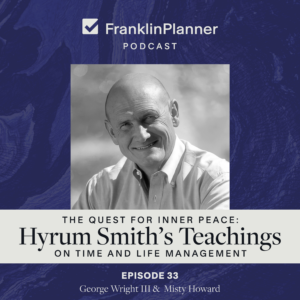
George Wright III is joined by Misty Howard to introduce a new series covering Hyrum Smith’s book “The 10 Natural Laws of Successful Time and Life Management.” They explain that audience feedback prompted more content on the planner’s timeless principles, emphasizing that the methodology is about more than efficiency in an “age of time famine.” They discuss Smith’s concept of inner peace as the result of aligning daily actions with core values, using examples like the “ladder against the wrong wall” and a seminar attendee who prioritized time with his son and later felt no guilt after his son’s death. Misty shares Hyrum’s background, including turning down a lucrative job to start a seminar company that became Franklin Quest.
00:00 Why Franklin Planner Matters
02:27 Meet Hyrum Smith
05:51 Time Famine Problem
08:36 Inner Peace and Values
11:35 Hyrum Smith Life Story
15:36 Executive Letter Lesson
Thank you for joining us on this Journey to create your best life and to lead your Life and Teams. Please share this show, and we look forward to the journey we will take together.
Check out the New Membership Program Here: https://store.franklinplanner.com/lps/membership/
The Franklin Planner Team

In this episode of the Franklin Planner Podcast, host George Wright III is joined by Misty Howard to begin a deep-dive series into Hyrum W. Smith’s classic book, The 10 Natural Laws of Successful Time and Life Management. Together, they explore the introductory section, “Why Should I Read This Book?”, unpacking why modern productivity isn’t just about managing time or packing more tasks into your day. Misty shares why true fulfillment comes from discovering your core values, aligning your daily actions with what matters most, and embarking on the ultimate human pursuit: achieving inner peace.
Episode Timeline
00:00 – Welcome & Introduction
01:03 – Timeless Principles & What Draws Us to Time Management
02:03 – Who Was Hyrum W. Smith?
04:19 – Chapter Overview: Why Read This Book?
05:51 – The Age of Time Famine vs. True Efficiency
08:12 – Defining Inner Peace & Core Values
11:35 – Living by Principles: Hyrum W. Smith’s Personal Story
15:15 – Alignment in Action: A Story of Guiltless Peace
8:09 – Values-Driven Living vs. Standard Productivity
21:13 – Next Episode Preview: Natural Laws
Episode Transcript
George Wright III: Okay, welcome back to the Franklin Planner Podcast. My name’s George Wright III, I’m your co-host, and John Harding isn’t with us this week, but we are joined by Misty Howard. How are you doing, Misty?
Misty Howard: I’m doing great. Happy to be here.
George: I’m glad to have you here, and for those of you first-time listening, I wanna make sure that you subscribe to the podcast. We have a bunch of really cool things coming out. If you haven’t already gone over to franklinplanner.com, you’ll see our new membership content; we got all kinds of good stuff there.
A New Podcast Series
But today we’re excited to have Misty because normally, Misty, we have you here for our historical figures in history, but today we’re gonna be covering a different topic, and the reason is because we’ve gotten a lot of feedback from our audience wanting more content on the planner and the timeless principles that apply to the planner. So we’re gonna give a bit of an introduction and overview of what Franklin Planner offers, as well as some of the stuff that really created it from the beginning, right?
Misty: Absolutely. And yes, even though I’m here to discuss something different than I normally do, it’s something that I’m equally passionate about, so—I am a big fan of timeless principles and how we can apply them into our lives. So I think they all kind of fall into the same vein, really. And sometimes I wonder, George, about the kind of people that are listening to this. You know, what is it that draws somebody to the Franklin Planner Podcast?
Listeners want to find inner peace
Because maybe people are here because they want to manage their time better, they want to feel less stressed, get home from work earlier, feel less frustrated about life. But I think what it all boils down to is, you know, “I’m here because I want to feel better about myself and about my life.” And that’s something we all have in common. Everybody wants to live a life of meaning and purpose. We want to have control over our lives. We want to have what Hyrum Smith called inner peace.
George: Yeah, that really is, and of course, our listeners and our students and our clients and people that are following Franklin Planner, some of them have been for decades—following Franklin Planner and utilizing the tools, and love the timeless principles of Dr. Covey and Hyrum Smith. But it really does boil down to “How do we help you lead your life? How do we help you to create a life that you’re meant to live?”
Hyrum Smith’s The 10 Natural Laws of Successful Time and Life Management
And so today we’re gonna be talking about Hyrum Smith, and let me just do a quick introduction before Misty gets into this, because Hyrum was a co-founder of Franklin Quest, the company that developed and popularized the Franklin Day Planner, and it later merged with Covey Leadership Center to become FranklinCovey. And one of the pioneers of the company, I would say—and of modern, you know, time and life management—he, you know, he really did a great job of teaching individuals and organizations how to create daily actions with their highest priorities.
So he was the creator of the Franklin Planner time management methodology that’s influenced millions of people around the world, and he was the author of The 10 Natural Laws of Successful Time and Life Management, which is sort of what we’re gonna get into today. So he’s known for all of these true productivity principles as well as stuff that’s much more meaningful in life. Wouldn’t you say there’s just a huge foundation around what he’s built for the company?
Misty: Absolutely. Hyrum Smith, to me, is just such an inspiring figure. He’s somebody that was… He just had a gift for teaching and inspiring people, and he used it to help people improve their lives. And in the earlier days of the company, that was actually what he loved to do. He loved to be with people, teaching these things, and they had seminars all over the world. And this truly is what lit the fire for people. This is what inspired them and helped them to realize, “Wow, this really does apply to my life.”
And it has been a little challenging since he passed away to try and duplicate that kind of experience. And so, fortunately, he did write a lot of his ideas down—pretty much all of the content that he would teach in these seminars—in the book, which you already mentioned, George, which is called 10 Natural Laws of Successful Time and Life Management.
George: Yeah.
Breaking it down chapter by chapter, month by month
Misty: Which is going to be the focus of this podcast series that we’re doing. We’re gonna take it chapter by chapter, breaking down all of these ideas, and I’m gonna do my best to try and channel my inner Hyrum Smith [Laughter] and try to teach these things in a way that hopefully will give you a similar experience. And today we’re starting with the first section of the book, which is called “Why You Should Read This Book.”
George: Yeah. Yeah.
Misty: And originally we kind of wondered, “Are we gonna cover that? Should we…?” It’s a pretty small section, but it’s very powerful, and it really, I think, is the thesis statement, you might say, for the whole book: teaching about what inner peace is, how we achieve it, and how we can use these tools to improve our lives. So, today we’re just gonna give you an overview.
George: Yeah, it’s interesting, and so just to be clear, uh, if you’re listening to this, over… you know, once a month, we’re gonna have Misty back, and she’s going to be covering these chapters of this amazing book. And I think you’re right, Misty; I think sometimes people skip over this first section, but I really think it’s important because it builds a foundation, and it really helps to set…you know, everything in motion as to why all of these principles are important, and they’re more than just time management. Because, you know, Hyrum Smith believed, and I’m sure you’re gonna get into this, that a successful life went well beyond time management and productivity. So let’s start with that. What do you think he meant by that?
Efficiency versus Effectiveness
Misty: Well, in the book, Hyrum Smith, he talks about how we live in what Time magazine dubbed an age of “time famine,” which means that people just are constantly feeling like, “I need more time.” We’re so busy. We’re constantly chasing new things, and if you’re trying to compete—especially in the workforce or, honestly, in every aspect of life—it feels like life is just getting busier, and people are feeling like they’re slaves to their own schedule. The things that matter most in life are so often held hostage by the things that matter least, which leads us to feel out of control. Maybe you feel like a first responder that’s constantly putting out fires all day, and then at the end you wonder, “What was even the point? What did I accomplish today that was of any value?”
Don’t just move; move in the right direction
And most time management systems, they’re going to focus a lot on efficiency, which is important, don’t get me wrong. You know, it’s good to learn how to structure your day in a more efficient way so you can include more in what you’re doing. But it’s not just about learning to shove a little bit of extra into your schedule. Sometimes we start punching the gas before asking ourselves, “Are we even going the right direction?”
George: Right. Right.
“What deserves those hours?”
Misty: “Do I even know what direction I want to go?” The analogy that Hyrum Smith uses is “you’re climbing the ladder only to find out that it’s against the wrong wall.” And so these become much more fundamental questions. Being busy doesn’t necessarily equate to a happy or fulfilling life. So we have to ask ourselves the big questions, and I think we need to stop asking so much “How do I fit more into my daily life?” and start asking “What deserves those hours?”
George: Yeah. You know, I think this is the point that we really have to hammer home for this episode and moving forward is that, if you’re listening to this and you’re feeling overwhelmed, like you talked about, or maybe multiple times in your life you’ve felt the ladder was against the wrong wall, it always comes back to the same thing, in that problem is not time. It’s not managing your time more, like you said.
Finding Inner Peace
You know, Hyrum Smith talks about this idea of inner peace because— and that’s one of his guiding philosophies. So maybe that would be a good next thing to sort of talk about. What do you think he means by that? Because if time is not the problem—with all these things we’re trying to manage our time, control our time—how do you come towards inner peace and lead your life around that philosophy?
The gap between actions and values
Misty: Yeah. Hyrum Smith actually said that the focus of the book was not exclusively on time management, but it was on achieving this inner peace. And so, to kind of explain what that means, because that might seem a little bit vague: If you’re feeling unhappy with your life, chances are there is a gap between what you do every day and what you value. Hyrum Smith believed and taught that the secret to achieving inner peace was understanding our core values, meaning the things that are most important to us in life. And when you begin to understand that, then you can evaluate and think, “Well, am I actually doing the things that matter the most to me? Or again, am I being held hostage by those things that I don’t truly even care about?”
Try writing out your priorities
So, for example, say that you write down a list of the priorities in your life. For a lot of people, you’re gonna see some similar things: probably family, relationships, work, health, service, integrity. Those are what I’m talking about: core values. And so you would then take those values and say, “Okay, how much time do I actually spend on those things that I claim to value?” Say that you put family as the number one on your list, and then you realize, “Oh, I actually don’t really spend a lot of time with my family.”
George: Right.
Align your priorities with your actions to feel good
Misty: That’s what’s going to create the discord inside you. You’ll feel that you’re doing something wrong. And so it’s when we begin to align our actions and our values that we can start to feel both good about ourselves and about our lives. That’s where we find that inner peace.
George: Yeah. This is the struggle, right, that everyone has, and if they’re listening to this podcast, they’re probably thinking that same thing. They’re like, “Look, we all want inner peace. That sounds like a really great thing to have.” And, but as a guiding principle and value, it really does drive the alignment of your actions.
So, as you talked about before, it not being, you know, time not being the problem, it really is about starting with what you value most and want to accomplish in your life, like the inner peace, and then aligning your actions and things around it. And I do, I think most people struggle with it, and they don’t know really where to begin, which is why this book is gonna talk so much about it, and they’re gonna, you know, we’re gonna go through all of these things. ’Cause of course time management is important, but you have to begin with the right foundation.
Hyrum Smith’s Life Management Journey
And I think Hyrum was a really good example—not just in teaching this, ’cause I think you’re right, the seminars and things he taught, people really got, you know, fired up from the conversations, and it reminded them of what’s important. But he also was a really, really good example of this in his life. And so not only was a good example, and maybe you have some ideas of this you could share with us, or at least some examples that he showed in his life.
Misty: Yeah, Hyrum Smith… I think that when you study his life, you start to realize, “Oh,” well, he definitely lived the things that he taught, and he saw that these things bear fruit, you might say, from personal experience.
Hyrum Smith, even from the time he was a child—and again, he’s telling this little piece of his life story in the beginning of the book, which, again, is a good way for us to frame this—so from the time he was a child, he had almost what he calls an obsession with making a difference in the world. He wanted to improve people’s lives.
“Teaching is what I love to do”
And so that became a driving force for him, and he actually discovered a talent when he came out of college for selling and marketing. And so he got involved with a big firm, found a talent for speaking and selling products, and then he ended up taking a three-year absence from that to serve a mission for his church where, again, he discovered that he’s like, “Man, teaching—teaching is what I love to do. That’s what I feel passionate about, and I think that that’s the way to make a difference in people’s lives.”
And so coming back from that, though, he started to ask those big questions of, “Well, what am I gonna do with my life?” And I find that this is common among people, especially my age, of “What do I do with my life?” But you’re never too old or too young to begin asking those deep questions of, “What do I want my life to look like and represent?”
So Hyrum Smith is asking those questions, and as he does that, he actually ended up getting a job offer to become a senior executive at a firm in New York, which was very lucrative position. And so he thought about it, and as he was thinking, he again came back to that value that he had of, “Well, I feel like I’m supposed to teach, and I don’t feel like I can do that in that position,” and so he ended up turning down the job, which many of his colleagues thought he was totally crazy for not taking it.
Starting the business and the planner
But instead, he and his family embarked on a really risky venture of starting their own seminar company in 1981. And so that’s what they did, and originally he looks back and says, “Ah, they were okay. We had a long ways to go.” And so you, as you kind of explained a little bit about his life, he would develop that and go on with some colleagues to eventually create the Franklin Quest Co. and develop the planner and the tools surrounding the planner.
And it’s through that he… eventually that the company in less than nine years would go from something that was just built out of his basement to something that became a multimillion-dollar company that was teaching seminars all over the world and changing millions of people’s lives. And Hyrum Smith says that he looks back at that decision he made to not take that job and to embark on something that was far more difficult and uncertain as one of the big turning points of his life, and it all came down to those governing values.
He leaned into his unique talents
George: Yeah, I was gonna say, Misty, it’s so interesting because it’s not unless you’re following your beliefs and values and important things, and not just managing your time, that you identify your core talents as well. And he clearly leaned into his unique talents. But I think it’s a lesson in itself that you lean into your unique talents when you’re actually focused on valuing inner peace, you know, things that you want to do in your life—hence Lead Your Life podcast, right? So I know you’ve got some other examples of this, so keep going.
Misty: Well, yeah, I’m glad that you brought that up, though, because again, the talents making a difference—Hyrum Smith, through the planner and through this company, that’s how he felt that he was fulfilling that desire to change people’s lives, and he has. I mean, just personally, I can say that these principles have been a huge game changer for me in my life. But he actually got a letter, and I wanna include this because I think it’s a really poignant example of how these ideas in practicality can change somebody’s life.
Truly making a difference
So he got a letter from this executive that he’d met at one of the seminars who had come up to him after and said, “You know, I’d never considered this idea of my governing values and how my schedule should be aligned with what I believe.” And so he’s like, “I’m gonna apply that.” Well, about a year after he met this executive, he got a letter from him, and in the letter he told him about how after looking at his values, he realized that right at the top was making a good life for his son. But then when he looked at what he was doing every day, he realized, “I’m not actually putting any time toward developing a relationship with my son or making him happy.” And so the rest of the letter told him about how he had planned all of these great activities with his son and how much closer they had become, and then he reached this part of the letter, and I’m just gonna give you a little snippet from it.
He wrote, “Hyrum, last week my son, eight years old, was killed in an automobile accident. I have experienced some real pain at the loss of my son, but I have to tell you that I have experienced no guilt. For the first time since your seminar, I realized what you were talking about when you discussed the idea and concept of inner peace.” And then he closed the letter by saying, “Hyrum, thank you.” I think that—
George: That’s crazy.
Misty: Yeah, right? But how many times, though, do people reach the end of their lives and look back and say, “I wish I’d spent more time doing…” blank? And I think what Hyrum Smith is trying to help us achieve here is to begin with the end in mind. It’s like, well, plan out your life to be what you want it to be, and to focus on those things that you want to invest in so that at the end of your life you can feel peaceful about the decisions you made.
Beyond Tips and Tricks
So the bottom line is, like, do you see the difference between this type of philosophy versus just a regular time management program? It’s the difference between following your values and just getting more done. Not that—again—we’re trying to say that you shouldn’t get more done. That’s not it.
George: Right, right. You gotta do that too.
Misty: But this is so much deeper. It’s beginning with what matters most to you, and then the rest should or can drop out of your life.
George: Yeah, and it really helps you to feel like you’re in more control as well, right? Um, you know, I think that there’s a quote, and I can’t remember who said it, but there was a quote that I’ve come back to many times that says something like, you know, “Don’t let your vision of the future rob you of the joy of the present.” And I think sometimes we’re just so caught up in managing our time and trying to control things that we forget the most important things. So that story you shared about the executive, that is such a great example.
And, you know, if you don’t wanna get to the end of your life where you’re wondering if you were, “I was super productive ’cause I had all my time managed, but did I accomplish what I wanted to do?” You don’t wanna get to that point, then you’ve gotta prioritize inner peace. You’ve gotta prioritize your values. And, you know, time is not the problem. Having a focus of your values and following your unique talents and these things. That’s why I think this whole chapter really sets us up really well, um, as we get going into learning.
And so what other thoughts do you have maybe to wrap up this particular section that we’re gonna talk about, or lead us into what we’re going to be talking about?
You are in control of your life
Misty: Well, we’re definitely gonna be diving into these concepts and other ideas much more deeply in the coming podcasts. This, though, I hope gave you an idea of what sets Franklin Planner apart and what it offers. Because what it’s offering you is inner peace, again, finding that oneness that comes from aligning with your values, but also feeling more in control of your life. Maybe you’ll be able to stop feeling like your life is running you, and instead feel that you are running your life.
Hyrum Smith said this: “I believe that the quest for inner peace and the happiness that comes with it is a life ambition of every person on the planet. Ultimately, we want to feel good about ourselves. We want to be excited to get up in the morning. We want to be in control of what can be controlled. The exciting thing is that this is not only possible—it is also doable.”
George: Yeah.
Solid principles and natural laws
Misty: I think that this is great because this book is not built on tips or tricks. It’s built on solid principles that time and time again have proven to be true. Again, there’s a reason why it’s titled “the laws that govern success,” right? Notice that word in the beginning of the title. This is something that has been proven by millions and millions of people who have seen it make a huge difference in their lives.
George: Well, and Misty, before we end here, I also was gonna mention, you know, I think that’s what a lot of people have really recognized with Franklin Planner: we’re not doing a podcast about planner tips. I mean, there’s strategies and tips and things like that, but it’s—and the Franklin Planner is an amazing tool to help guide you and keep you focused on what matters most, that is the whole point behind it—but there’s got to be this foundation, and there’s got to be more in your life that will help you to stay focused on what matters most and keep going in the right direction and also remind you in this digital-overwhelmed world that we have. So what are we gonna be talking about in our next episode?
Misty: We’re gonna be talking about natural laws and what they are because, again, going back to tried principles, this is built on things that exist outside of ourselves. So if you wanna be successful, find out the laws that govern that success, and we’re gonna talk about that in depth next time.
Check out the Franklin Planner membership
George: I love it. I love it. So if you’re listening to this, and if you’re listening for the first time, make sure that you send us some feedback. We really wanna hear from you. We wanna know what you’re working on, what you’re celebrating, what you’re struggling with. That’s the reason we’re doing these podcasts, and so each month, we’re gonna focus on different chapters within the book, and we’ll talk about natural laws this next month, and then we wanna hear from you in between. And if you haven’t already, go check out the membership program. We have a lot of podcast extras and behind-the-scenes podcast insights. You can go over to podcast.franklinplanner.com. We’ll put some links in the show notes, but we really appreciate you.
Misty, thank you for joining us today. We’re looking forward to more on this, and I know you’ve been studying and putting some real effort into this, so thank you for being here as well.
Misty: Yeah, thanks for having me.
George: All right, guys. Listen, if you have any questions, make sure you get back with us. We look forward to talking with you again on the next podcast. Have an amazing day.
Thank you for joining us on this Journey to create your best life and to lead your Life and Teams. Please share this show, and we look forward to the journey we will take together.
Check out the New Membership Program Here: https://store.franklinplanner.com/lps/membership/
The Franklin Planner Team
About Misty Howard
Misty Howard is a historian‐enthusiast and podcast host who brings a fresh, youth-oriented voice to timeless values and historical wisdom. She serves as the creator and host of the podcast Faith Ignited (described as “Immersive, real stories from history, seen through the lens of faith”). Her work focuses on exploring the lives of influential historical figures—especially from the founding era of the United States—and connecting their personal values with modern leadership, mission-driven living, and character development. Misty emphasizes the importance of self-improvement, purpose, and narration of historical truths often overlooked in mainstream narratives. Her style blends historical research, faith-based insight, and practical application for younger audiences.
Her contributions bring depth, perspective, and inspiration to conversations about proactive living and principle-centered leadership.