Are you ready to discover the keys to greater productivity and lead your life and team with principles that stand the test of time? Welcome to The Franklin Planner Podcast, your weekly guide to achieving your best life through proven strategies, timeless values, and expert insights. Whether you’re looking for ways to boost your personal productivity, lead your team to new heights, or find lasting success, this podcast is your trusted companion on the path to intentional living.
For more than 40 years, Franklin Planner has helped millions infuse their lives with meaning and clarity. Inspired by the principles of Dr. Stephen R. Covey and his groundbreaking work, The 7 Habits of Highly Effective People, this podcast builds on that enduring legacy. Hosted by Franklin Planner Board Member and Owner John Harding, alongside industry expert George Wright III, each episode dives deep into the essential habits, disciplines, and leadership principles that transform both individuals and teams.
Together, John and George bring decades of experience, combined with interviews from accomplished business leaders, productivity experts, and success coaches, offering valuable lessons you can apply today. From overcoming roadblocks and staying focused on the “Big Rocks” in your life to fostering collaboration and trust in your team, the discussions are rich with actionable takeaways and practical wisdom.
The Franklin Planner Podcast is more than a tool for learning; it’s an invitation to a community committed to growth, purpose, and intentional living. If you’re ready to take charge of your time, lead with integrity, and craft a legacy of success, this is the podcast for you. Tune in weekly, and let’s unlock your full potential—one timeless principle at a time.
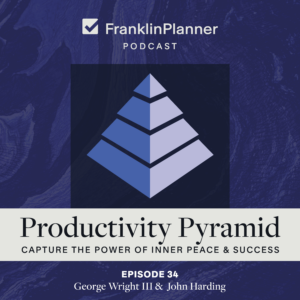
George Wright III and co-host John Harding explain Franklin Planner’s foundational Productivity Pyramid as a companion to the Time Matrix, designed to connect what matters most to daily action and “inner peace.” They outline four levels—governing values, goals, weekly planning, and daily actions—framing the key question of how priorities make their way into everyday life. They discuss identifying values , translating values into season-specific goals, and why weekly planning creates the best daily plans. John offers a weekly planning review process, cautions against too many or misaligned goals, and shows how daily planning and the important/urgent Time Matrix help handle interruptions while staying aligned with values.
00:00 Why the Pyramid Matters
06:17 Four Levels Overview
07:23 Governing Values Foundation
11:23 Turning Values Into Goals
15:41 Weekly Planning Power
20:57 Weekly Planning Checklist
22:51 Daily Planning and Time Matrix
26:58 Quotes and Listener Challenge
Thank you for joining us on this Journey to create your best life and to lead your Life and Teams. Please share this show, and we look forward to the journey we will take together.
Check out the New Membership Program Here: https://store.franklinplanner.com/lps/membership/
The Franklin Planner Team
About Misty Howard
Misty Howardis a historian‐enthusiast and podcast host who brings a fresh, youth-oriented voice to timeless values and historical wisdom. She serves as the creator and host of the podcast Faith Ignited (described as “Immersive, real stories from history, seen through the lens of faith”). Her work focuses on exploring the lives of influential historical figures—especially from the founding era of the United States—and connecting their personal values with modern leadership, mission-driven living, and character development. Misty emphasizes the importance of self-improvement, purpose, and narration of historical truths often overlooked in mainstream narratives. Her style blends historical research, faith-based insight, and practical application for younger audiences. Her contributions bring depth, perspective, and inspiration to conversations about proactive living and principle-centered leadership.

On The Franklin Planner Podcast, hosts George Wright III and John Harding explore the core framework of personal effectiveness: The Productivity Pyramid. From bridging the gap between high-level values and daily actions to achieving true inner peace, this conversation illustrates how clarity, discipline, and intentional choices help you align your calendar with what matters most.
John breaks down the four foundational levels of the pyramid, offering insights on defining governing values, setting goals tailored to your current season of life, and utilizing weekly planning to navigate daily demands. The conversation highlights the synergy between the Productivity Pyramid and the Time Matrix, key wisdom from productivity pioneers like Hyrum Smith and Stephen R. Covey, and actionable Franklin Planner practices—such as a 5-step weekly review process—to help you eliminate daily noise, focus on Quadrant 2 priorities, and lead your life with purpose.
Episode Timeline
00:00 – Welcome to The Franklin Planner Podcast
00:54 – What is the Productivity Pyramid?
02:09 – Overview of the 4 Levels of the Pyramid
07:24 – Level 1: Discovering Your Governing Values
11:20 – Level 2: Translating Values into Goals
15:43 – Level 3: The Power of Weekly Planning
20:58 – 5 Steps to Execute a Weekly Review
22:52 – Level 4: Daily Actions & The Time Matrix
27:00 – Timeless Quotes & The Weekly Challenge
Episode Transcript
George Wright III: Okay, welcome back to the Franklin Planner Podcast. My name’s George Wright III. I’m here with my co-host, John Harding. John, how are you?
John Harding: Doing great, George. I’m excited to be with you today to talk about the Productivity Pyramid.
George: Yeah, so am I. You know, we’ve had so many requests from individuals. The Productivity Pyramid, it’s one of the most foundational concepts of Franklin Planner, and we want— you know, I think people want this topic because they wanna have progress in all areas of their life—their health, their finances, their relationships, work, purpose—but all those priorities don’t always translate to daily action. So tell us what is so important about the Productivity Pyramid before we get going here, because I think that we wanna make sure everyone has a context for how to use this, whether they’re a Franklin Planner user or not.
John: This is an awesome companion tool to the Time Matrix. And whether you’ve heard of the Productivity Pyramid or not, we’re gonna share it today. It’s a simple model. A lot of times when people think about planning, they often picture appointments and lists of things, but we’re gonna go deeper today, and we’re gonna tie it together.
George, you get through a day, and you could just… It could’ve been a day kind of overflowing with how busy you are—even a bunch of important things—but this is something that will really help you, that when you come to the end of a day, you can really say, “Hey, I really got the things that line up with what matters most to me.” So you’re— it puts you kind of in the driver’s seat, ahead of the game, and then after the day to really be going where you wanna go, even though you can’t predict everything. So it’s a cool model that we’re gonna go through.
George: That’s awesome. Yeah, and I think it would be good for us, and for our listeners, to start with the big picture and why this framework is so, you know, central to the Franklin Planner approach, but also in their everyday lives. So talk to us about why does the Productivity Pyramid matter, but maybe even break down the four levels, and then we’ll drive deeper into each of those levels.
Why the Productivity Pyramid Matters
John: I’d love to do that. And then as I was planning for this, there’s just kind of a simplicity to it, that as you work through it, and even reviewing it, it gave me insights. Think about this for a minute, a little behind the context of why. When people think, they look ahead and they think about what they want in the years ahead—there’s research from Pew and also some others, AARP and others—but here’s some of the things that people typically think about when they think about the years ahead.
Thinking ahead
They talk about their health. They talk about having financial security. They talk about close relationships. They talk about also making a difference, you know, their purpose, service. And also time to enjoy things, to sometimes travel, leisure kinds of things. So as they think about that— And so that kind of a picture, you know, really kind of calls to question, “How do we do that?” you know, and “What do we do next Tuesday or next week?” So as we think about the different parts of someone’s life and how they hope to create it and lead it and live it well, this is what the Productivity Pyramid is all about.
Wisdom from Hyrum Smith
Now, I’d like to put out there one… If I were to think of Hyrum Smith, who I knew fairly well, I heard him speak before I joined Franklin Planner through when I was at Deloitte, IBM, Price Waterhouse; they were starting to use the Franklin Planner, and Hyrum would come and speak. Then after I joined Franklin Planner and was on what we call the senior management team, I spent a lot of time—I don’t know how many times I have heard Hyrum W. Smith describe what we’re gonna walk through in a few minutes today, but it was powerful.
And he had one conclusion, kind of one in his words, but I’m just gonna give you his quote, and so I’d just like to kind of pose it to you as a practical question, and this sets it up: “How do the things that people care about—” So think about the things—those could be people, goal, your mission, your dreams—we say are most important to us, how do they “make their way into your daily life?”
Achieving inner peace
And what Hyrum’s promise as he started in the middle and at the end of when he taught the power of this planner—and this pyramid is really a system that you work through continually when you use writing down and thinking and drawing out of you inspiration—and it was that the way you would live your life daily and weekly, but at the end of a day, as you looked at what you did, you could see that what you did lined up with what you valued, and the term he used was “inner peace.” That that would bring you inner peace to live according to your values. So that’s kind of the Hyrum Smith.
We say, “What’s the benefit of what we’re gonna talk about?” I’m gonna also give you some Stephen Covey quotes, but that’s kinda “What are we looking for?” And we might say, “Hey, you define, you put that in your words, but whatever for you is what you want to accomplish.” And most people do wanna be in charge of their life rather than have someone else or circumstance come upon you. So it’s kind of that “lead your life,” inner peace, and do the things with the people, you know, that matter most to you.
The Four Levels of the Productivity Pyramid
So then you asked me to outline the pyramid, so let me give it to you. Imagine a pyramid that has, you know, this hard, strong base, and it’s one of the most sturdy structures as we’ll talk about that we have. And imagine four levels. At the base of this is what we call governing values, and we’re gonna start there as we talk about it. You go up one level, and you have your goals. You could think short-term, long-term goals. You go up one more level, and it’s how to apply those values and goals and what you do on a weekly basis, kind of a weekly perspective. And then the top of this pyramid is and would be your daily actions. So: governing values, goals, weekly planning, and what you do daily. That makes up the structure of the pyramid that we’ll explain today.
George: I really think this is a simple system for people to answer that question: “How do you go from taking what matters most to applying it in your daily actions?” So before we talk about goals and schedules, we really have to get clear first about what actually matters. So let’s start with the foundation, the governing values. How does someone identify their governing values and build that strong foundation to start?
How to Identify Governing Values
John: Yeah. It’s a great question, because it sounds a little formal, doesn’t it? “What are your governing values?” Here’s maybe just some simple way to think about it and how to discover it. I’d start with just your real life. Like, what people and commitments, you know, would you deeply feel sorry if you connected? Or another way, you know, how would you feel like your time would be so well spent? What kind of a person do you wanna become or do you wanna present or have people think about, you know, when they think of you? So this is a great place. This is the base of the pyramid.
I’m gonna mention that also down here at this base—some things that we feel so strongly about, but we’re not gonna go into today—but I just wanna connect you to what’s also there: your vision as you, you know, as you think further in your life, long-term, kind of of where you’d like to be and end up, and then maybe a little more near-term or sometimes—this is also a match to governing values—but we use the word “mission” sometimes, or your purpose. So just imagine those things are hanging out down here in governing values.
I’m gonna mention one more, and it’s your roles in life. And that really also exists very well at the goal level. We’ll talk about that. So those are just some other ways you can think about— Hey, this is you thinking and getting your own inspiration. You can model your life after and according to timeless principles and people you admire, but this is just kind of that base.
I’m gonna give you some other examples. Someone might name, put some words to this. They might say faith, family, integrity, learning, health, service, craftsmanship. You know, what is your craft? What are you, you know, the best in the world at, or could be, or what do you have to offer that nobody else has to offer? Financial responsibility. So these words are important, but really what’s most important is the meaning, you know, that goes beneath that. So when I say family, what do I mean? I might mean being available to someone who needs me, the people who need me that I wanna help succeed.
So those are some examples of how to think about it. And this is a little more of a match to what I was trying to say about Hyrum, where he was saying, “When your daily practices reflect your governing values, what’s at this base, you experience inner peace.” So we’re looking to define that so that as we go up the Pyramid and we think about how to plan, we have a line of sight. And life isn’t perfect. You know, the plan is made, you’ve gotta be flexible, but it’s incredible. This works. It’s worked for many years, and it works. It’s powerful.
It’s important to begin with the foundation
George: Yeah, and I think it’s very important for us to comment about this and say, look, the goal here is most people try to just fit what’s important into their schedule. We’re beginning with the foundation. So as long as you are remembering that you don’t have to overthink it, the point of the matter here is this: What is most important in your life? And doing this exercise will help you to really dig into, you know, mission, purpose, roles, goal, or roles, and things that are important to you. And, you know, as part of this podcast, maybe we could do some extras, John, as well.
But as they now get this foundation of the values that are important and you begin from that, we then move into goals. Because once we know what matters, the next challenge is really translating values into something that you can actually have for purpose. So how do we turn a value into a meaningful goal for whatever season of life someone’s in?
Converting Governing Values into Meaningful Goals
John: A great question. And you know, the power of goal—we’ve now done two forty-five-minute podcasts on goal—go check that out, because as you and I did that, even the years we’ve been studying goals—
George: Yes.
John: —it is phenomenal what setting a goal and, which is going to be one more step of detail and saying, “If I value this, how can I act on that?” You know, “What can I do?” So think of it this way: What would meaningful progress look like in this season of my life, specific to one of these values, or maybe a couple of these values that come together? A value can endure decades. A goal that expresses it may change, you know? And it doesn’t mean your values can’t adjust and refine, but you adjust that goal to the season of your life.
Let me give you—I’m thinking of a health example, and I’m thinking of a family example, and later we’ll use a, you know, a team or organizational example. But let me just, let me give you a health example. My health matters because I want the energy [Laughter] to do the things as I go forward in my life that I love to do. I mean, of course, I wanna be alive and healthy. I’m gonna give you a personal example.
John’s personal values of health, family, and joy
For years I’ve water skied and my family’s boated, and it’s kind of like snow skiing is old-school for some and, you know, snowboarding is new-school. I love surfing. Surfing now you can do behind boats, it’s amazing. But we had a water ski course, we’d set it up, we’d ski it, that’s all I did. We’d go on vacations, and between water skis, we’re in the place watching Bob LaPoint, you know, go around these buoys. Well, recently, with just a little more age, holy cow; it is hard for me to even get up. When I get up, I can ski pretty great. But now, it’s getting up, and that’s just age. So that’s an example of health related. I really value just the joy that brings, doing that with my family. So that’s a health example.
But let me give you another one related to a goal. Suppose your value is connection with family. And at one stage, your goal might be to establish, let’s say…a weekly conversation with a child who has moved away. At another stage, so another season in your life—and so these goals adjust—but as we go up the pyramid, it might be to make a regular time with your spouse, you know, to spend that time. It also might be making regular time with an aging parent or someone you might be serving. So that’s an example of a goal and how that follows valuing family, valuing health. Take it up to a goal.
George: Yeah, you know, John, you said something that really kind of struck me and—you know, maybe I’ve heard it before and maybe not, but it just in the context here, but as you create these values, which is what’s most important to you, and now you wanna translate this into some actionable items, and so we move to the next level of the Productivity Pyramid, which is goals—you said the term “meaningful progress,” and I really think that that’s a great insight because, just like we don’t want you to get too caught up in your purpose and mission so much as identifying what’s valuable to you in your life, goals can be nothing more than meaningful progress. And so at different seasons of your life, your meaningful progress is the goal in the areas, whether it’s family, health, you know, wealth, working, whatever. So I love that, and I love that term.
Weekly and Daily Planning
But as we move from values to goals, then the power really comes into this weekly planning, right? This is where we begin moving from the bigger goal into more practical… Like your actual schedule. So why do we plan the week before we plan the day? And talk to us about that level and that step in the Productivity Pyramid.
“The week is the perfect perspective”
John: When you make this step between a goal, also George, and… “Well, what will I do now?” You know, what’s that initiative? You’ve clearly planned. You have been very intentional in determining your value and your goal, and now you really need to take some initiative. It’s getting closer—you know, we’re gonna get to the day as well—but the week is a perfect perspective.
Be realistic and authentic when planning your goals
But before I go a little more into that, I wanna mention some mistakes that we see people make, and that I’ve made as well. And these are questions you and I have talked about, you know, and some of them are, “Well, how many values?” You know, and “How many goals?” And, you know, I don’t know the exact answer to that. We used to give an exact answer, but we do know this, that fewer— you know, that if you have many, it’s very unlikely that you’ll accomplish them. That doesn’t mean you can’t have several values and group them. And so I don’t wanna say two or three or four to five because I don’t wanna be limited by that, but fewer. So one mistake is trying to set too many goals, at least at the same time.
Another mistake, sometimes a goal like, even, you know, “Here’s the weight I wanna be,” or “Here’s…” Something might sound good, and I don’t mean this to put myself or anybody down, but sometimes we might pick a goal that really isn’t what really fits us and that we really want. Or it might sound impressive because someone else wants us to do it.
And that doesn’t mean that we shouldn’t listen to others that are so important to us. In fact, that’s one of the keys that we want— we don’t have time to go in today, but to draw a circle around yourself and say, “Who are the most important relationships related to me and my roles, and how can they help me?” And to gather, you know, advice from them. I think I’m gonna take this opportunity to give you the Stephen R. quote: “Seek first to understand, then to be understood.” And you can apply that so well as you take yourself through the Productivity Pyramid from goals now as we go up to weekly and we think about priorities.
Zoom in with daily planning
So a single day gives you a narrow view. You can see your commitments. You can see your available time at the beginning of a week and the roles that need attention. It’s close enough to really be real, like you’re gonna take initiative tomorrow and the next day. But it’s this cool… as if you had a camera and, you know, you zoom in. It’s the appropriate zoom-out. And I’ve said this before, I just love this. People sometimes say, “Well, is the planner, you know, is it just a calendar? Is it just a list of things to do?” And as I’ve gotten a little more experienced, I’m like, “The calendar is unbelievable.” If you get it, and you understand day and night and how they roll into weeks, and as you put what you want together, it’s amazing.
“The best daily plans emerge from weekly plans”
Here’s another idea. The best daily plans emerge from weekly plans. A week gives you room to decide when important things can happen. So it’s just a great— it’s not complicated. Seven days. It gives you the right scope to kind of take things and order them and place them before the day comes.
George: Yeah. You know, and I think I’ve learned one thing over the years and over the thousands of interviews and things that I’ve done, is that successful people—people that have more purpose-aligned, driven lives, that lead their lives—plan on a weekly or monthly or annual basis. In other words, you know, when you’re trying to plan what’s most important—and I love that we’re starting people from values and then driving to goals and then going to this weekly plan—like you said, it gives them enough time to decide but also to prioritize, whereas we all know what it feels like when you’re just planning your day and you’re trying to cram everything in.
So I love the power, and that’s why this section, it really is the power of weekly planning. Not scheduling your week; it’s weekly planning. And so you’re right, it is a really powerful thing. And I’ll tell ya, you know—and John, you’ve seen this more than anyone ’cause you’ve been with Franklin for so long—but when you do it in this order and you’re working through the steps of values to goals to weekly plan, things just sort of fit in place versus going the other way around, which is what most people do with a calendar. Wouldn’t you agree?
John: Yeah, I would. And George, I’d like to just, I was thinking earlier as I was planning for this, and I decided I would write down just a simple review for a listener. So first, look back. So here we are, we’re gonna take a look at weekly planning. We’ve gone from values, we’ve gone up one level to goals, and now we’re looking at the week and saying, “How do we apply these goals that matter?” We know they’re grounded, we know they’re anchored, and we know it matters so much.
A Simple Planning Routine
So first, look back. What moved forward last week, and what needs to be carried over or reconsidered in this next week? Second, review your values and review your goals. Open your planner, rewrite them. We know science behind that. You get more inspiration when you rewrite, when you review. Third, so number three, look ahead at what’s already on the calendar and where the genuine openings are. You can do time blocking—the morning, the afternoon, the evening. There’s some cool ways you can do this.
But choose a few actions then; number four is to choose a few actions you can schedule and prepare. And the fifth would be make realistic commitments, leaving room for work, people, and, you know, things that change, what we might call surprise. And then you can just put one goal through this process. And the beginning of the week—whether it’s Monday, whether it’s Sunday, whether it’s Saturday, whatever your day is—I invite you to really apply this.
Real-world application
George: Yeah, ’cause it’s really not just planning your week. It is a weekly planning process, so I love how you walked through that whole cycle. But, you know, ultimately the system comes to that very top of the fourth step, the top of the pyramid where ultimately the system has to work in the real world. So when, you know, your priorities are competing, and interruptions and, you know, urgent demands on your time, so how do daily planning and, like, the Time Matrix work together in this step to help you to be effective?
John: Your daily plan is where intention meets initiative and reality. So you look at the commitments already on your schedule. You review actions that you identified for the week that are now falling on that day. But you still got the week in mind when you approach each day as well. So these things are… they work together, right? In some way, as we have models and frameworks, they just give us a way to learn principles and apply skills.
I like to sometimes say, “Hey, start anywhere, go anywhere.” [Laughter] If you started the week, go back, right? And look at your goals and reconsider your values. So it isn’t meant to be, you know, robotic. It’s a powerful set of principles with a framework so that you keep asking, “What are the most important things that I can actually do today?”
The Productivity Pyramid and the Time Matrix
And, you know, some tasks as we think about the Time Matrix, it’s this powerful kind of X, Y, or has four quadrants and, you know, one of the X-Y axes is what is important, and what is urgent is the other one. And we define Q2, or Quadrant II, as this place where it’s non-urgent, but so important. And that, that’s really the question that is liberating. But George, some tasks are important, some are urgent. A genuine deadline or an immediate problem to solve does deserve attention, for sure.
Revisit values and goals to stay in Quadrant II
But some of the activities that most shape your future are this Quadrant II. They are not demanding your time, but they are so important. And I think I can give you an example of that. But the Pyramid helps you know what… you know, what is important. And you combine that with this idea— The idea of what’s important and urgent isn’t just daily, right? It’s also weekly. So it really hangs out in those top two. But the guidance to know what to do weekly and daily is you continually revisiting your values and the goals and making sure you’re on signal. You know, you’re aligned with that.
George: Yeah, that is so true. And, you know, look, we do this topic because it’s a great example of how to take these timeless principles that are important, and tie them to tools and systems that can help you to apply them, because it doesn’t matter whether you’ve learned these principles a hundred times or not; most people are just caught up in the day. They’re caught up in, you know, distress and stress and priorities.
It’s all about leading your life
And so the simplicity of these timeless principles, I find it ironic that it’s a productivity pyramid, but really what it is, is it’s a “lead your life.” It is, how do you take what’s important, craft goals, weekly planning, and daily, apply it in a system so that you will stay to both being intentional with your life but also leading your life and getting the results you want, because, John, that’s really what it’s all about, right? People are trying to get the results they want in their life.
So maybe you could give us an example or a challenge for our listeners before we go here, because I think that the topic is one that resonates really well with a lot of people listening. But what’s the challenge you would give someone so that they can just start to apply what we’re talking about today?
Some Quotes to Consider
John: Let me make the challenge kind of with two parts. I’d like to give you three quotes. So part of my challenge is just to think about if these principles fit you and will always fit you, no matter what season of life you’re in, and if there’s something that can be helpful to you. So these— See where you think these fall in the Productivity Pyramid. So think of the values anchored at the bottom, goals, weekly planning, daily planning. For what purpose? To help you lead and succeed in your life and help others do the same.
So here’s a quote from Stephen R. Covey: “It is incredibly easy to work harder and harder at climbing the ladder of success, only to realize that it’s leaning against the wrong wall.” And so where do you think that falls? Think about that. Um, weekly planning, you’re climbing that, but values and goals. So that’s a good one.
Here’s a Hyrum Smith: “When your daily practices reflect your governing values, you experience inner peace.” We mentioned that at the beginning. And then the third Stephen R. Covey one: “Putting first things first means organizing and executing around your most important priorities.” So that’s really, really huge.
I’m gonna give you one more because I think then I’ll just end with this challenge. Stephen R. Covey: “Anything less than a conscious commitment to the important is an unconscious commitment to the unimportant.” Stephen R. Covey. You gotta think about that.
Take the initiative to make a plan
Okay, so here’s the second part of my invitation, George. First of all, as you make a plan, we all know that it gets interrupted. So a plan is a guide for choosing and adjusting. It isn’t that there won’t be all kinds of development. So it’s not a guarantee that nothing changes, but asks what truly must be handled now, you know, in your life, and what can be scheduled, what can be declined. And that’s a lot easier to do and know when you’ve thought about it ahead of time. And then return to your priorities again and again.
And, you know, when I think about, like—you’ve said this before—hey, so completing the daily task is one benefit, but it’s so much bigger than checking it off, right? The check mark matters, and because of the action it supports. But over time, you can really begin to see a connection to these quotes and these principles that the smallest step back through the week and the goal to the value that made it worth doing. It is liberating, and it brings you personal power, and I believe it opens you to be healthy enough, to be confident, to be more confident. So it’s not just peace, although peace seems like an ultimate reward.
Maximize the power of your Franklin Planner
So I just invite people to try this, to use this, to walk through it. And if you don’t have a Franklin Planner, honestly, get one. Get one where you can have it anchored historically, you can go back, you can have it by dates. And in our membership, we’ve decided to pack in here a bunch of tools and support that will help you do this. And so I just invite people to do this in a way with the goal, “Hey, I am going to draw out the greatness in me, and I’ve got this really cool limited resource of time, and I’m in charge. I’m an agent to act, you know, and I know I have some skills and tools to do it.”
So I’m a huge fan of this, and I’m grateful for this Pyramid, George, and the chance to talk about it and invite others, you know; invite everyone to revisit it or give it a try and see what it can show you maybe that you hadn’t seen before. And it might be also easier than you think to lead your life in these areas with these tools.
George: I think whether you’re using a Franklin Planner or not, it’s obviously a great system and a tool for you to apply the Productivity Pyramid. But take this week and go through that. You know, go through the values, go through the goals, set your week and your daily priorities and activities, and see what kind of change that makes for you in your life.
So if you’re listening to this and this is the first time, go back through it. If this is the tenth time or hundredth time, go back through it, because we can promise you that these timeless principles are timeless for a reason. They do create results in your life. They will help you to lead and be intentional with your life.
And so John, thank you so much for sharing all those thoughts. And for those of you guys listening, please do us a favor. Send us some thoughts. Let us know what you’re working on, what you’re struggling with, what you’re winning at. We like to celebrate the wins and also bring you topics and ideas that will help you.
We’ll put some links in the show notes so you can get some additional content on the Productivity Pyramid, and we really appreciate you being part of our community. We look forward to serving you more and look forward to talking with you again soon. So have an amazing day. We’ll talk with you then.
Thank you for joining us on this Journey to create your best life and to lead your Life and Teams. Please share this show, and we look forward to the journey we will take together.
Check out the New Membership Program Here: https://store.franklinplanner.com/lps/membership/
The Franklin Planner Team