Are you ready to discover the keys to greater productivity and lead your life and team with principles that stand the test of time? Welcome to The Franklin Planner Podcast, your weekly guide to achieving your best life through proven strategies, timeless values, and expert insights. Whether you’re looking for ways to boost your personal productivity, lead your team to new heights, or find lasting success, this podcast is your trusted companion on the path to intentional living.
For more than 40 years, Franklin Planner has helped millions infuse their lives with meaning and clarity. Inspired by the principles of Dr. Stephen R. Covey and his groundbreaking work, The 7 Habits of Highly Effective People, this podcast builds on that enduring legacy. Hosted by Franklin Planner Board Member and Owner John Harding, alongside industry expert George Wright III, each episode dives deep into the essential habits, disciplines, and leadership principles that transform both individuals and teams.
Together, John and George bring decades of experience, combined with interviews from accomplished business leaders, productivity experts, and success coaches, offering valuable lessons you can apply today. From overcoming roadblocks and staying focused on the “Big Rocks” in your life to fostering collaboration and trust in your team, the discussions are rich with actionable takeaways and practical wisdom.
The Franklin Planner Podcast is more than a tool for learning; it’s an invitation to a community committed to growth, purpose, and intentional living. If you’re ready to take charge of your time, lead with integrity, and craft a legacy of success, this is the podcast for you. Tune in weekly, and let’s unlock your full potential—one timeless principle at a time.
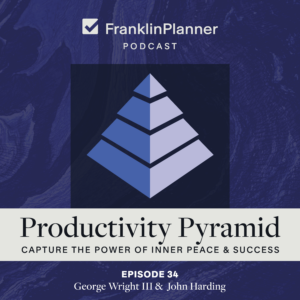
In this episode, co-hosts George Wright III and Franklin Planner Board Member John Harding delve into the significance of defining one’s mission, vision, and values. They discuss how these elements can help individuals find purpose and direction in their lives, referencing concepts from Stephen Covey and the Productivity Pyramid. The conversation covers practical steps for self-reflection, crafting personal vision and mission statements, identifying core values, and understanding life roles. The episode also highlights the inspiring story of David Anderson, who credits his personal mission with transforming his life. Listeners are encouraged to take time for self-reflection and to write down their mission, vision, and values to live a more meaningful and proactive life.
00:00 Introduction and Episode Overview
00:32 The Importance of Mission, Vision, and Values
01:16 Stephen Covey’s Influence and Key Concepts
03:29 The Productivity Pyramid Explained
07:31 Steps to Establishing Your Foundation
19:06 Defining Your Core Values
21:44 Understanding and Prioritizing Life Roles
Thank you for joining us on this journey to create your best life and to lead your Life and Teams. Please share this show, and we look forward to the journey we will take together.
The Franklin Planner Team

In this episode, co-hosts George Wright III and Franklin Planner Board Member John Harding delve into the significance of defining one’s mission, vision, and values. They discuss how these elements can help individuals find purpose and direction in their lives, referencing concepts from Stephen Covey and the Productivity Pyramid. The conversation covers practical steps for self-reflection, crafting personal vision and mission statements, identifying core values, and understanding life roles. The episode also highlights the inspiring story of David Anderson, who credits his personal mission with transforming his life. Listeners are encouraged to take time for self-reflection and to write down their mission, vision, and values to live a more meaningful and proactive life.
Episode Timeline
00:00 Introduction and Episode Overview
00:32 The Importance of Mission, Vision, and Values
01:16 Stephen Covey’s Influence and Key Concepts
03:29 The Productivity Pyramid Explained
07:31 Steps to Establishing Your Foundation
19:06 Defining Your Core Values
21:44 Understanding and Prioritizing Life Roles
Episode Transcript
George: All right, we’re back with another episode, and I’m super excited today. Um, my name’s George Wright III. I’m your co-host here with John Harding. How are you doing, John?
John: I’m doing great. I am excited today to talk about mission, vision, and values—and what that’ll do for people and what that does for us.
George: Yeah, and I think it’s important for us to do this. We both talked about this before the show—we want to have this topic because so many people in life right now are just going through the motions. Um, you know, and a lot of times we talk about productivity and productivity tools, but we don’t stop to give a little bit of background and foundation into this. Because people—a lot of them—are thinking, “What am I doing?” and “What’s the purpose behind what we’re doing?” So help me get an idea of why, and let’s just kind of set up this conversation today as to why this is important—why this topic is important for everyone.
Why Vision, Mission, and Values Matter
John: Stephen Covey really captured it in the first two habits: be proactive—this is all about taking responsibility for your life. And then the second habit—to begin with the end in mind.
So, if you’ve heard these words “vision,” what’s your vision—that’s kind of a long-term view.
What is your personal mission for your life, your contribution on earth, or what do you want to do to help those around you? What’s your purpose? So are you mission-driven? Do you know where you’re headed? Think of that. And then, a key component of all of that is: who you care about, your roles, and what do you care about—what values, what principles do you have? That kind of wraps up together, I think, to say, Hey, you’re here on Earth. You know your time is limited, and there’s brilliance in people. There’s greatness in people. And I think the challenge is—you know, people like you said—where are you going? What’s coming at you? What’s possible? I think when you think about that, to look at the power of a mission and vision and defining that can really draw people’s potential to the top.
George: Yeah, and I think it’s all about being intentional. In other words, we are so fast-paced in our society right now that we’re just about, “How can we do more in less time?” And let’s be honest with it—we’ll talk about the productivity pyramid and all these, you know, mission and vision and roles and values—but you’ve gotta have intention behind it. And these timeless principles we talk about—with Stephen Covey and with our tools and things—they have to go hand in hand, right? And so I know people a lot of times think that’s a very ambiguous conversation. It’s like, “Where do I want to be and my passion,” and all these things. And I know we’re gonna drill into some of these levels. But how does somebody—where does somebody start? Is it about just being self-reflective on their life? I mean, where are they starting and how do they start to take action into translating that into a plan?
The Productivity Pyramid
Understanding the Foundation
John: Yeah, great question. There’s something called the productivity pyramid that has been a key part of the planner and the Franklin planner and the process. The base of that, George, is what you value. So imagine a pyramid that maybe has four levels to it. That base would be your mission, your vision, your values—that’s your anchor. When you say, “Where does somebody start?” I think the mindset that’s key is to really believe: inside you is greatness, and you can lead your life. So, if you’re gonna lead your life and then go about each day, what do you care about? What’s your purpose? Where are you headed? So let me just say that the base of this pyramid would be the values and mission.
The next level up might be your goals—short-term and long-term goals. And the next level would be taking a look at, really, the calendar. What does a week look like? Weekly planning.
And then the top of that would be taking on every day—seize the day, right? Carpe diem. And so we’re gonna focus on that base—how to anchor yourself. Another example might be a lighthouse. You know, where, what is your anchor?
Reassessing Over Time
George: So let me ask you this—this is a great starting place for a lot of people, even if they’ve gone through the process of determining what their vision and their mission is. Is this something that you recommend someone does? We’ve kind of said it is productive to do on an annual basis. Do they do it on a monthly basis? I love the idea of the productivity pyramid, which we’re gonna dive into, and it’s a great starting place, but is this something that someone should come back to? Is it gonna be a conversation that’s gonna happen over and over throughout your life?
John: Yeah, that’s a great point. It’s something you have to establish.
So think of footings—foundation of a building. Then I believe it can change with different phases of your life and as you go along. But you can build on it, for sure. It’s gotta be something you review weekly and know where you’re headed because everything that comes at you—a lot of urgent stuff comes at you—and some of that is important, but a lot of really important things are not urgent. Establishing who you want to be, putting it in writing, and reflecting on it and letting it evolve is definitely something that you gotta do if you really want to, I think, live a meaningful life.
Applying Mission, Vision, and Values Personally
More Than Just Business
John: I do think it’s interesting—people might hear this and think, “Hey, I’ve heard of this at the organization I worked for,” and that’s something maybe we’re familiar with. Very few people seem to have tapped into the power of doing this. I will say though, that over the last 35 years, it’s been a key part of the mindset and the process—the strategy—of Franklin Planner. And so we have some amazing customers, partners, that have just proven this, and they just swear by it, in terms of really thinking about and being proactive—taking responsibility.
George: Yeah, well you made two really important distinctions. One is that you may have been familiar with the productivity pyramid over time, but your life changes. And that’s why it’s good to revisit this on a weekly basis. And then also, this is principles and things we’re going to talk about that are applicable for both a personal level and a team level. And we’re going to drill really into the personal side here. But I really love this foundation. So today we’re going to talk about the productivity pyramid, and we’re going to talk about that base level—the level that really involves your mission, vision, and roles.
So the base of this productivity pyramid is where we’re going to start.
Help me understand what’s involved with this foundation that we’re trying to set up.
John: There are five steps to this.
- The first is self-reflection and discovery.
- Then craft your vision statement.
- Then develop your personal mission statement.
- Then look at your core values—those principles that matter to you.
- And then make sure that you’ve checked, enlisted, and prioritized your most important roles.
So let’s start with step one.
Step 1: Self-Reflection and Discovery
George: Great, so we’ve got our baseline. This is how we’re going to be doing this. And step one is that self-reflection and discovery, which is good because everybody needs to start there.
So where do they start?
John: So there are a couple of exercises here. One is to just think about your core values. Now, core values might be those principles that you care most about. Here’s an example: reflect on what matters to you in your life—integrity, growth, family, health, service. Those are examples of things you value. Some people would list trust and things like that. Ask yourself: what principles guide my decisions? What makes me fulfilled or feel meaningful?
George: Got it. No, I like that. Because you’ve said that in other episodes as well—like, look, if you’re not constantly asking yourself what matters most to you, your values and things like that, then all of your planning could be in the wrong direction. So I think that’s really good.
And then this first area also sort of involves determining your purpose. And I know that’s a real ambiguous topic for a lot of people. So help me understand how someone can really drill into what their purpose is.
John: Well, one way to do it is to ask yourself a few questions: What impact do you want to make in the world? I like thinking about—and a lot of people don’t take time to do this, and that’s the purpose of this podcast and some other things—believing there is a unique contribution that only you can make. And George, we all are unique in many ways. We might share strengths in some cases, but reflect on moments when you felt most alive, most on fire, most passionate.
And also give yourself time to—if you haven’t experienced that—know that you can. If you take time.
I want to say too—this is key—you know, go somewhere where you can be with a pad and paper. Kind of put interruptions aside to do that.
George: Yeah, and I think this is a feeling as well, right? What makes you happy? What drives your purpose? And know that you’re unique and individual.
So as you start to reflect and you really drill into your purpose, then it’s going to take us to this idea of creating a personal vision statement. And I know sometimes people mix up vision and mission, but let’s start with a vision.
Step 2: Creating a Personal Vision Statement
What Is a Vision?
What is your personal vision, and how do you craft a personal vision statement?
John: Think long-term a little bit here. It could be five years, it could be ten years, it could be twenty years. Just try and think—what is your ideal future? Take time and think about that. Ask yourself that question.
A great professor at Stanford—Ed Batiste—has this concept I think is called “unique self-coaching.” And if you give yourself time and ask yourself questions, you’ll be amazed at the inspiration you get. Whatever your belief system is, whatever inspires you—you take time and do that, and you will get great ideas, and you need to follow those. So the long-term view—a little bit of what you want to be.
Here’s another great exercise:
Imagine it’s your funeral, and you’re at least 80 or 90 years old—let’s put it out there. And the speakers at your funeral—who are they? And what are they saying about you? Go ahead and write what you hope they will say about you, and what you would like said about the contributions you made. That’s another way—it’s kind of an exercise to get you thinking. Brainstorm that way.
George: Yeah, I actually like—when I’ve done this exercise before—I love the concept of both what the future version of yourself is, and what the future version of your life is. Because you may be wanting to live a certain type of life, but also: what do you want to be remembered as, and who is that version of yourself? I think that’s a great idea because that also is a way for you to have something to personally develop towards. So that vision is a great place to start.
Step 3: Developing a Personal Mission Statement
How Vision and Mission Differ
But how does that differ—how is a personal vision statement different from your mission statement and what you’re trying to accomplish with a mission? Talk to me about personal mission.
John: Your mission statement defines your purpose and is more like a compass. You say, “Hey, I want to climb that mountain over there. Okay? And when I get there, here’s what it’s going to look like. I envision this when we arrive.” Your purpose gives you that direction and helps you head that way.
As you go further up the productivity pyramid in this strategy—that is really a great way to look at things—you do put more detail on how you’re going to get there. But think of some of these questions to help you understand your mission and start to think about that:
What am I passionate about?
How do I want to serve others?
What unique strengths do I bring?
And then you begin to write: What is my mission? What is my purpose?
So think purpose.
George: Got it.
John: And what could drive you if you were clear about who you wanted to be and what you wanted to accomplish—maybe short of step-by-step detail goals before that step.
George: I like it. So, you’ve got this self-reflection, and you’re defining this clear vision of where you want to be, and your mission is sort of—like you said—a compass to get you there.
Whether you want to be an inspiring person, or whether you want to do—you know—how you’re going to approach getting there. Not so much the game plan, like you said, but it’s about what is it that you’re passionate about and what inspires you along the way to get there for your mission. And I think—I mean, we don’t have the stats—but I don’t know very many people that have actually written down their vision and their mission. But this is one of the reasons I really love the principles combined with the tools of the planner, right?
The Power of Writing It Down
So how important is it for people to write this stuff down?
John: Well, it’s huge. Now we know there’s science behind this—and we’ll continue to touch on it—but when, just like with a goal, as you even go deeper than a goal and you write down who you want to be, the principles you want to live by, where you hope to go—the power inside you and your brain…There’s brain science that says your brain immediately begins to solve for that. Begins to help you work on that. So it’s huge.
George: Yeah, I think that’s such a huge part of what people don’t do, right? We even had that episode on goal setting, and you talked about the science behind just simply writing goals—and who does and who doesn’t—and the, you know, 10X effect of productivity. So this is good.
Okay, so we’ve got now some self-reflection. We’ve got our vision statement, our mission statement, and we’re going to get into our core values and roles.
Actually, before we do that, I was thinking about something we were talking about before the show. And now that we’ve kind of talked about vision and mission, you had an example of something you came across. Talk to me about what we were talking about before the show. Share that with the listeners.
Inspiration in Action: The Story of David Anderson
A Powerful Example of Living with Purpose
John: One of the best examples I’ve ever seen—and we have great examples of mission-driven people—Lindsey Vonn, Michael Phelps, others, Nelson Mandela… Anyway, there’s a list.
But there’s a gentleman by the name of David Anderson, and he did a TED Talk in 2016—you could look it up. He is so mission-driven, and he credits his mission with literally saving his life.
So a little bit of background—he grew up in Chicago, a little bit of the rougher side of Chicago. He had 12 childhood friends that died because of gun violence. His mother had leukemia at a certain point, mixed with some mental and emotional challenges.
And here’s a couple of his quotes:
He said, “I could not get bitter. I had to get better.”
He read a lot of books. And here’s an interesting thing—when he met his wife, he said he didn’t have much to offer, but he had a mission.
George: Nice, yeah.
John: And so he gives this amazing—I think it’s an amazing—example of the greatness in somebody, but when everywhere they look around, it looks like everything’s caving in on them.
George: Well, and to your earlier point in the podcast—be intentional. You might have everything working against you, but just going through these motions will empower you in your life. So, yeah, go ahead.
John: Yeah, and I think his example is extreme, and it’s almost like books and scripture—there are extreme examples we can learn from. I’m sure everybody listening—whether they’re very familiar with this or not—is facing some kind of major obstacle. He had several at once.
So here are some of the other things he did: He had somewhat the sense at age 19, in the middle of a lot of chaos, to write his mission. And here it is:
“I pledge allegiance to my success.
I pledge allegiance to do my very best.
I do believe I will succeed.
Nothing will stop me. Nothing will drop me.
I have a purpose to fulfill.
I have a future that is very real.
No matter what happens or goes on around me,
I will not sink. It will not drown me.
I pledge allegiance to my success.
I pledge allegiance to do my very best.”
Now, he credits that with helping him have the vision, the passion, to just deal with obstacle after obstacle. And he’s become a very accomplished and successful individual.
George: Yeah, he did a TED Talk, he’s done all kinds of different things. And I think that’s a great example, so I’m glad we stopped for that. Because it’s a great example of—when you are—like you said, separate yourself, get in the quiet, and do this process—you are going to carry that throughout the chaos of your day and your week and your life. And when you have that mission—and that mission statement specifically—it’ll help carry you.
Step 4: Defining Your Core Values
What Are Core Values?
So we’re going to talk now about defining your core values. Let’s talk about: what are the values, and how do they relate to your vision and your mission?
John: George, your values are the guiding principles that shape your behavior and your decisions. Here are some steps to consider as you go through this:
Brainstorm 10 to 15 values that resonate with you. So just pull out a whiteboard or a piece of paper and go after that. Narrow them down—narrow those to three to five that are kind of your non-negotiables. And then make sure they align with your vision and mission. And I would say this—consider the principles. So if they’re principles, they’re based on truth, they’re based on timeless principles. You know, in this case, like a lighthouse—it’s anchored. That’s a key part of The 7 Habits of Highly Effective People: principle-centered living, leadership, and leading your own life.
George: So these are core values we’re talking about, right? Like—what’s important to you and what’s going to guide you—like integrity, growth, service, or whatever it is. But these are your core values that are going to kind of keep you on the path with your mission and to create your vision, right?
John: They are. And I think—let’s just step back for a minute and take a view of why this is important again, in kind of the flow of living life. You take a day and the different things that can happen to you and those that you care about in a day—whether it’s work, family, home, health, whatever it may be—as those come at you, these values are truly that anchor and base that will help you know how you’re going to respond, how you’re going to act or react, how you’re going to choose. So they really are a filter that helps you make that decision and is really key.
If the people that don’t— They’re really key because the people that don’t have that are kind of like a ship without a rudder, right? You get tossed back and forth. And again, the urgent will push out the important. But if you have your values, you’re anchored.
George: Yeah. So if you have identified those, then it’s sort of your litmus test against all the things you’re bumping up against. You remember, and you know, and you’re conscious of what’s important to you.
Step 5: Identifying and Prioritizing Your Roles
Roles Give Structure and Focus
And so the last step in this base of the productivity pyramid that I really like—and I think is unique to these conversations and the discussions of Dr. Covey are—is this idea of your life roles. Because so many times we’re just so overwhelmed with everything going on in our life that we don’t really look at it from the perspective of roles. So let’s kind of finish this discussion with that topic. Help us with that one.
John: That’s huge. And you’re right—it is unique. You don’t see that, and Dr. Covey had really brought that out. So think about your different roles. Here are some examples—you could be a father, a mother, a leader, a friend. You could be a coach.
Here’s another key thing to keep in mind: this could be current roles or it could be future roles. So it doesn’t need to be exactly where you are—but think about what you have, who you are, and what you want to be. And then after you do that, define what success looks like in each role. And then you may want to prioritize your roles.
Most likely, as you consider those, you might even realize, “Hey, I could do more—there’s something I could do. A role I could have that I don’t.” You also might go the other way—you might say, “Hey, I’m trying to do too many things here, and I can’t serve that.” I think it also falls under the heading of “who matters most”.
George: Right, well, so these go hand in hand with values, right? Because if you’ve—and this is why you’ve got to have these steps—if you value your relationships over, let’s say, your career, then when you start to look at these roles and you try to define your goals—and what we’ll be getting into as we go up the pyramid into these ideas of productivity and goals—But these values and roles go hand in hand into how you’re going to lead your life. Like you’ve said many times before—what matters most and who matters most. And now you have this solid baseline and this base to be able to start to plan and grow and build your life. And you’re not a rudderless ship like you’re talking about, right?
John: Right. And so you align your values with each role to ensure balance and fulfillment.And let me just bring it back to the day for a second—
At the end of the day, we’ve said this before: as you think about what matters most to you, you may not have gotten everything done, but if you’re clear about your mission, you’re clear about your governing values—we use that word “governing” to help you govern, right?—to help you lead your life…You may not have gotten everything done that you hoped to get done, but if you’re clear about this footing, this foundation, the things that got done most likely will be the things that mattered most.
Final Thoughts and an Invitation
The Power of Living with Intention
George: Okay, this has been a great conversation and discussion, and I really love how we’ve kind of wrapped up this base and this foundation of the productivity pyramid. So as we end our show, what do you want to leave the listeners with? What key points do you want to leave them with?
John: I want to emphasize—based on hundreds of examples—the importance of a personal mission statement and defining your governing values. And George, you say, “Well, why is that important?” And I think it’s huge to at least make this claim—and this is one we stand by:
Within each of us is this tremendous potential—greatness, brilliance—and we have the ability to lead our life despite forces around us that might say otherwise. Remember David Anderson—in the midst of all of his trouble, he somehow had the good sense to create a mission.
Here’s the invitation I’d like to give:
Find somewhere quiet. Think. This is not that difficult, and it will be rewarding. Sit down and start to brainstorm, to develop what matters to you—your mission, your vision, your values—with this goal in mind: you’re going to masterfully win each day. It’s kind of like the U.S. Constitution—a great set of guidelines to live by.
Life is short, and every day matters. Defining your vision, identifying your core values, defining the roles that matter most to you—this also defines a mindset for actually each thought that goes through your head. How do you want to show up every day? Visualize it, and it will inspire you. You’ll be able to draft that mission, and you will be mission-driven. And the promise is—you won’t be forced to react to external forces. You’re proactively taking responsibility and creating a great life and capturing the great potential you have.
George: Yeah, and it’s not just about winning the day and the productivity of the day—which we will do, of course—it’s about living a meaningful life. And so that was well said. I appreciate that.
And for everybody listening, we do want you to take that invitation. We promise that it will create change and fulfillment in your life. And do us a favor—if you would, share this show. We want to share this message. We want to share these timeless principles with people to help them to live their best life and to lead their teams. So thank you for joining us today. Make sure you check the show notes for any resources that we have, and we look forward to talking with you on the next episode. Have a great day.
John: Awesome.
References
1. Covey, Stephen R.
The 7 Habits of Highly Effective People. Free Press, 1989.
Referenced for foundational concepts such as “Be Proactive” and “Begin with the End in Mind.”
2. FranklinPlanner
https://www.franklinplanner.com
Referenced as the planning system behind the Productivity Pyramid.
3. TEDx Talks – David Anderson (2016)
I Pledge Allegiance to My Success
Search “David Anderson TED Talk 2016” or visit https://www.ted.com for more details.
Referenced as a real-life example of living by a personal mission.
4. FranklinCovey
https://www.franklincovey.com
Referenced as the organization continuing Stephen Covey’s work on principle-centered leadership and personal effectiveness.