Are you ready to discover the keys to greater productivity and lead your life and team with principles that stand the test of time? Welcome to The Franklin Planner Podcast, your weekly guide to achieving your best life through proven strategies, timeless values, and expert insights. Whether you’re looking for ways to boost your personal productivity, lead your team to new heights, or find lasting success, this podcast is your trusted companion on the path to intentional living.
For more than 40 years, Franklin Planner has helped millions infuse their lives with meaning and clarity. Inspired by the principles of Dr. Stephen R. Covey and his groundbreaking work, The 7 Habits of Highly Effective People, this podcast builds on that enduring legacy. Hosted by Franklin Planner Board Member and Owner John Harding, alongside industry expert George Wright III, each episode dives deep into the essential habits, disciplines, and leadership principles that transform both individuals and teams.
Together, John and George bring decades of experience, combined with interviews from accomplished business leaders, productivity experts, and success coaches, offering valuable lessons you can apply today. From overcoming roadblocks and staying focused on the “Big Rocks” in your life to fostering collaboration and trust in your team, the discussions are rich with actionable takeaways and practical wisdom.
The Franklin Planner Podcast is more than a tool for learning; it’s an invitation to a community committed to growth, purpose, and intentional living. If you’re ready to take charge of your time, lead with integrity, and craft a legacy of success, this is the podcast for you. Tune in weekly, and let’s unlock your full potential—one timeless principle at a time.
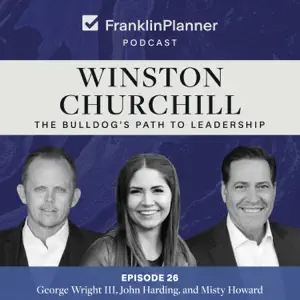
George Wright III hosts John Harding and resident history expert Misty Howard on the Franklin Planner/Lead Your Life podcast to discuss Winston Churchill as a leadership model and why studying historical figures reveals timeless principles from “beginning to end.” Misty outlines Churchill’s difficult upbringing (wealthy but neglected, poor student, speech impediment, harshly criticized by his father), his early writing success, and his Boer War capture and daring escape that made him famous and launched his political career. They cover Churchill’s flaws, depression (“black dog”), and major mistake in World War I (Gallipoli), emphasizing that leaders need purpose and commitment more than perfection. Misty explains Churchill’s “wilderness years,” his warnings about Hitler, and how appeasement failed, leading to his rise as prime minister and his “We shall fight” speech in 1940. The hosts conclude with takeaways about mission, courage, preparation, and daily intentionality, then promote upcoming episodes, a Lead Your Life magazine, and a Franklin Planner membership.
00:00 Welcome and Guests
00:31 Why Study Leaders
01:58 Churchill Relevance
04:45 Early Life Struggles
10:48 Boer War Escape
16:27 Flaws and Resilience
20:12 Gallipoli Setback
23:27 Wilderness Years Warning
26:12 Standing Alone
31:23 Destiny and Preparation
34:59 Fight on the Beaches
41:03 Final Takeaways
46:12 Closing and Next Steps
Thank you for joining us on this Journey to create your best life and to lead your Life and Teams. Please share this show, and we look forward to the journey we will take together.
The Franklin Planner Team
About Misty Howard
Misty Howardis a historian‐enthusiast and podcast host who brings a fresh, youth-oriented voice to timeless values and historical wisdom. She serves as the creator and host of the podcast Faith Ignited (described as “Immersive, real stories from history, seen through the lens of faith”). Her work focuses on exploring the lives of influential historical figures—especially from the founding era of the United States—and connecting their personal values with modern leadership, mission-driven living, and character development. Misty emphasizes the importance of self-improvement, purpose, and narration of historical truths often overlooked in mainstream narratives. Her style blends historical research, faith-based insight, and practical application for younger audiences.
Her contributions bring depth, perspective, and inspiration to conversations about proactive living and principle-centered leadership.
Guest Resources:
Podcast Link: Faith Ignited — available via Apple Podcasts, Pocket Casts, etc.

George Wright III hosts John Harding and resident history expert Misty Howard on the Franklin Planner/Lead Your Life podcast to discuss Winston Churchill as a leadership model and why studying historical figures reveals timeless principles from “beginning to end.” Misty outlines Churchill’s difficult upbringing (wealthy but neglected, poor student, speech impediment, harshly criticized by his father), his early writing success, and his Boer War capture and daring escape that made him famous and launched his political career. They cover Churchill’s flaws, depression (“black dog”), and major mistake in World War I (Gallipoli), emphasizing that leaders need purpose and commitment more than perfection. Misty explains Churchill’s “wilderness years,” his warnings about Hitler, and how appeasement failed, leading to his rise as prime minister and his “We shall fight” speech in 1940. The hosts conclude with takeaways about mission, courage, preparation, and daily intentionality, then promote upcoming episodes, a Lead Your Life magazine, and a Franklin Planner membership.
Episode Timeline
00:00 Welcome and Guests
00:31 Why Study Leaders
01:58 Churchill Relevance
04:45 Early Life Struggles
10:48 Boer War Escape
16:27 Flaws and Resilience
20:12 Gallipoli Setback
23:27 Wilderness Years Warning
26:12 Standing Alone
31:23 Destiny and Preparation
34:59 Fight on the Beaches
41:03 Final Takeaways
46:12 Closing and Next Steps
Episode Transcript
George Wright III: Okay, welcome back to the Franklin Planner Podcast, the “Lead Your Life” podcast. My name’s George Wright III, and I’m joined with two amazing guests, my co-host John Harding and our special resident expert Misty Howard. How are you guys doing today?
Misty Howard: Doing great. Yeah, happy to be here.
John Harding: Misty, good to have you here. This is awesome.
George: This is amazing. And John, we have been wanting to have Misty back on the podcast for a while, right? So, I’m excited to talk about Winston Churchill today. And maybe, John, you could give our listeners, if it’s their first time listening, maybe a feel for why we’re doing these historical figures episodes.
History Teaches Us Timeless Principles
John: I’ll do it. And thanks to everyone that’s put this together, and particularly, you know, to our listeners. So we hope you’re well, and it’s great to be with you. So Misty brings some unique aspects that really are interesting to us and, we believe, to our listeners. She is a podcaster, and she is a history enthusiast. And also, as we’ve learned about Misty and teamed up with her, I think she has a unique voice. You know, she represents young adults, and also I feel like, as we’ve discussed and now had several opportunities to look at history, to look at timeless principles, to do this leadership series, Misty is, I think, unusually grounded for her age and gives a cool perspective grounded on timeless principles. So I like talking with you, Misty, and I appreciate—we both appreciate—the research you do. And today, Winston Churchill. So it’s great to be together.
George: Yeah, this is gonna be a great topic because I think when it comes to leadership and leading your life and overcoming obstacles and trials, many of history’s figures have been great examples of that. So Misty, maybe you could start out by telling us, you know, what is it about Winston Churchill that makes his life so particularly relevant for people focused on leadership and direction and stuff like that in their life?
Seeing the beginning and the end
Misty: Yeah, definitely. Uh, I think just a note on why studying historical figures matters in general is that Stephen R. Covey talks about beginning with the end in mind, and that can be challenging when we don’t see the end. And history is great because we get to see the beginning and the end of somebody’s story.
Greatness takes time
And one thing I love about Winston Churchill is he faced a ton of setbacks in his life, and he was really preparing himself for something great, even from the time that he was a child, but it didn’t come immediately. It was something that, I mean— World War II didn’t hit until he was about sixty-four, a couple weeks before he turned sixty-five, I believe, so it’s not like it happened all at once. And I think he shows us that sometimes greatness takes time, and it takes a lot of patience. So we can look to him for that.
George: Yeah, that’s really great. And, uh, John, I was gonna kind of ask you really quick before we get into it ’cause I wanna start with a little bit of the backstory of Winston Churchill, but— Leadership and leaders, I mean, you’ve been with Franklin Planner for so long, I mean, you’ve been around some of the greats, um, Stephen Covey and many, many others. And Winston Churchill really is a leader that most people know, right?
“Your best work is ahead of you”
John: For sure. And you know, it’s interesting. History’s incredible. We’re making history here, right? And at least for our lives and our family, hopefully people will look back. But he’s fascinating, like many others, in that there were many events in his life—both difficult and maybe some victories as well, some wins—that prepared him long before anyone really kind of learned about him. And I think— I’m anxious for Misty to tell us a little bit about that. But George, he… You know, he emerged in his moment, and I’m gonna kinda save this till the end, but I have an invitation, you know, for all of us to— I think our best work is ahead of us. I’ve heard that a lot from Stephen Covey, and then more because I’ve spent more time with Stephen M. R. Covey. It is an inspiring thought. He tells me and he tells others, “Your best work is ahead of you,” and I really believe that for all of us. So—
George: Yeah, that’s a great point.
John: It’s interesting he used that.
George: It’s good because, you know, whether you’re listening to this podcast for the first time, by the way, or whether you have heard our episodes before, you know that our goal is to help you to lead your life, and create your life, and create your best life. And so let’s jump right into it.
Winston Churchill Before Fame
So Misty, for listeners who know Churchill primarily from the wartime-leader role he had, who was he before politics? Before, you know, he kind of established himself as “famous,” give us a little bit about that, maybe his childhood, maybe expectations he had. Just give us the backstory of Winston Churchill.
Writer, historian, statesman
Misty: That is such a great question, because a lot of people will recognize Winston Churchill as the British bulldog that saw Britain through the darkest periods of World War II—and rightly so. But serious students of Winston Churchill’s life will also recognize him as a great literary writer; he actually won a Nobel Prize in literature. He was a historian, he was a statesman, and all around just a very accomplished person.
“The product of unhappy childhood”
And I think that this quote from Winston Churchill that actually comes from one of his books, one of his most famous works that he wrote about his own ancestor, he said, “It is said that famous men are usually the product of unhappy childhood. The stern compression of circumstances, the twinges of adversity, the spur of slights and taunts in early years, are needed to evoke that ruthless [spirit].” And, uh, I think that that truly helps summarize Winston Churchill’s upbringing because it was not a very easy or happy one.
Now, it’s not that he was born into poverty; he actually was born into wealth. His family was very prestigious, but his father— So, his father was one of the younger sons of a very wealthy nobleman, and because of that, he didn’t actually have any wealth or title of his own because at that time, the oldest son pretty much inherited everything. So his father, Lord Randolph Churchill, decided to make his career in politics. That’s how he was going to make a name for himself. And this might surprise people: Winston Churchill is actually half American. His mother was the daughter of a New York financier who was very successful, so she came with a lot of money, but they both liked to live beyond their means.
And so because his father was so driven to be successful, he wasn’t around much. And his mother was a dazzling socialite that spent most of her time at parties and gatherings and rubbing shoulders with the elites, and he was left home alone. And actually, his nurse was considered probably the person he was closest to throughout his life. She was his best friend growing up and probably a surrogate mother for him. And he did love his parents, but they weren’t exactly present, and his father had very high expectations for him. And Winston Churchill was not very successful in school. Actually, he got pretty low marks consistently. He also got in trouble for misbehavior a lot, and so his father would reprimand him for that.
Only fit for the military
And, uh, you could say he was a neglected child. He wasn’t a very successful child, not somebody that you would think was geared to do something great. [Laughter] Um, actually, when he was getting into the Sandhurst Military College— Well, this is kind of an interesting side note: his father one time came into his nursery and saw him with his military playset and he was commanding these little soldiers, and he said, “Yep, he’s fit for the military. That’s about all he’s fit for.” [Laughter]
And so he decided that that was gonna be his career choice because he wasn’t smart enough to get into politics. And he ended up taking this exam to get into the Sandhurst Military College three times. He failed two times, finally made it in the third time, and he still was not able to make it into the elite infantry regiment that his father wanted him to. Because he got such low marks, he ended up being a cavalryman, which was more expensive for his dad, which obviously he was not happy about. It also was just a lot less prestigious. He actually wrote him this scathing, blistering letter saying, “You’re never going to amount to anything.”
George: Wow.
Misty: That is rough!
George: Pretty difficult childhood.
Misty: Definitely not easy, and he also had some other challenges, like he had a speech impediment—we don’t know exactly how severe that was—but at the very least, he had a lisp, and that was something that he had to spend his entire life overcoming to become a great orator.
George: Wow. So a difficult childhood, huh, John? Like a lot of stuff to overcome.
Misty: Yeah, for sure. For sure.
Prepared for Greatness
John: Well, I just think as we keep going here a little, keep this in mind. It seems like history remembers him, you know, for this fine— from his finest hour. But even so far, what you’ve said, Misty, you know, history forgets all the things that prepared him for that moment. So let’s just kind of keep that in your mind as we go through this, because I think it applies to each of us. You know, when every day is that opportunity, but there’s kind of a cool thing I think we’ll see at the end that we may be able to do. We may be able to dream a little bit about a finest moment, and whether that particular moment comes or not, [Laughter] I’m sure he had no clue what the exact moment would be. But there are a few things, Misty, you’re gonna help us draw out that I’m excited about that I think were keys that enabled him to forge ahead. So keep going.
Difficulty is what shapes us
George: Yeah, because difficult— I think that’s a great point, John, because difficulty in your childhood, in your upbringing, a lot of people see as real problems, but they are what prepare you, right? And, Misty, he had a lot of setbacks, like he had— So tell us the story of Churchill’s capture and dramatic escape during the Boer War, because I think that’s another example of overcoming a setback that he had, you know; it was kind of a pivotal point, right?
Misty: Yeah, it’s actually seen as one of the great turning points in Winston Churchill’s life. But before that, there actually was perhaps a more significant turning point, and that was losing his father. Winston Churchill was twenty years old when his dad died. And you would think that he wouldn’t have been particularly close to his father, maybe this wouldn’t have affected him that much, but it did affect him very deeply. When he heard news that his father was on the brink of death, he actually ran down the street to try and get there in time to see his dad.
And I don’t think he had a super tender interaction with his father, but as his dad passed away, it actually created in him this drive, maybe to prove his father wrong. And he no longer had his father there saying, “You’re not good enough,” or standing in his way. But I think more than anything, it was him saying, “You’re wrong. I will become something great.” But he also, because of this, became more acquainted with the family finances and realized that his parents were not in great financial straits. He did not have a lot to inherit. And he had tried his hand at politics before this and failed. He wasn’t well known enough. And so he ends up signing up to be a journalist. His father had done this too, where he would send in articles to make some extra money on the side.
Sent to the Boer War
So this is where Winston Churchill really becomes a noted writer, is by sending articles into newspapers, and people are saying, “Oh, this guy actually has some literary talent.” Well, when the Boer War broke out in South Africa, Winston Churchill wanted to be one of the first to go and report on it. And so he goes there as a journalist, hoping that the war is not ended yet. He’s saying, “I’m hoping that I’m gonna be able to capture this.” And so he gets there, but he is on an— he’s, um… on a train—this is a pretty crazy story [Laughter]—and the Boers— So the Boers are mostly Dutch farmers that are trying to keep the English from coming in and taking the resources in South Africa. And so they place the rocks in front of the train to stop it.
George: Wow.
Churchill escapes capture
Misty: And it does, obviously; it derails several cars. Some people get injured. Winston Churchill’s able to help move the rocks and get one of the trains back on track so that they can take some of the injured back, and the rest he’s helping to care for when he gets captured. Because the Boers show up, they take him as a captive, and the plan is to keep him until the end of the war.
Now, for a restless person like Winston Churchill, that was not gonna happen, and he decides pretty quickly that he’s gonna try and escape. Well, while one of the guards is not paying attention, he ends up scaling one of the walls. There are some others that are with him that he’s thinking might join him. They don’t end up making it. He’s the only one. So he’s alone, and he has to make this split-second decision: “Do I go at it by myself, or do I go back?” And of course, Winston Churchill decides to continue on himself. Now, he’s got three hundred miles between him and safety—
John: Wow.
Misty: —with a chocolate bar in his pocket. He doesn’t have a compass. He’s got— He has no map, is not super familiar with the area, and he ends up traveling at night. He’s able to climb onto some trains, and yet he is still a couple hundred miles from safety when he is completely out of supplies. And he ends up making a really risky decision to knock on a door, and it just so happens that that door belongs to a guy named John Howard. And John Howard is an Englishman, fortunately, and he hides Winston Churchill, takes care of him, helps him to get to safety.
The first whispers of fame
And by the time Winston Churchill gets there, there is already a warrant out for his arrest, dead or alive. They’re okay, it doesn’t matter if he’s captured either way. And so he’s able to get there. When he gets there, he sends word that he’s alive, and he actually will write an article describing his experience; this launches him into stardom in Britain, and this actually brings a lot of enthusiasm for the Boer War and morale boost to the British. And it’s because of this recognition that he finally gets the fame that launches him into politics. So it’s pretty important.
George: Well, some of the biggest issues become some of the biggest benefits, huh, John?
John: Yeah, it seems like— Misty, I know a lot of this we learn after, right? People, as we talked about, Ben Franklin and George Washington. But Churchill believed deeply in serving Britain, and he also wanted to preserve freedom, so while he may not— he may have written about that some, in retrospect we see his determination to get over that wall, to get out of there, to keep going, even at this age and where he’s not famous. He was driven by a deep belief, a deep kind of mission, set of values, and some real purpose.
George: Yeah, John, you make a really good point there, too, and it’s one to really note that— Perspective, right? At the time, like, he did not know what was gonna be his purpose and vision, although he might have had, like, a bit of a vision to push him forward. But his determination is what pushed him through it and literally is what turned that pivotal point into a major role in his life. Like you said, Misty, he had the choice of maybe going back or not.
A Flawed Leader
So it’s interesting. People see him as a very strong figure, remarkable strengths, but, from what I understand, he had some pretty significant flaws as well, right? Like, how did his life teach us about imperfections and things that he was not, uh, really very strong at?
Misty: [Laughter] Actually, this is one of the things that I love the most about Winston Churchill, is how flawed he is. He had a lot of strengths, very determined person, uh, probably persevered in ways that you hardly see in history, just overcame things constantly. But that being said, he wasn’t always the easiest person to get along with. They said that he could be OCD at times. He would struggle with people making noises or interrupting him.
Uh, he also— some might consider him like a high-functioning alcoholic. He pretty much didn’t go anywhere without a drink. He had drinks throughout the day, and yet somehow he still managed to accomplish what he did. [Laughter] Um, and he made some really tactical errors throughout his political career, ones that you think really could have sunk everything for him, and yet he still managed to be successful at the right moments.
Success is not perfection
And I think that this teaches us that you don’t have to be perfect to be successful, and we can overcome our weaknesses. Obviously he came with some of his own challenges and was able to, through practice and determination, overcome a lot of things. And even those weaknesses that he carried with him throughout his life, he still was able to have his strengths overcome those weaknesses.
John: You know, it stands out to me that there’s kind of a myth sometimes that great leaders are even fearless or without these flaws. And I think in Churchill’s case, he openly battled—you mentioned it—uh, self-doubt and depression. And he referred to this—and if I’m ahead of your story, or this one won’t come out—as the black dog. Now, I’ve had two— uh, I’ve had five Labradors, and actually three have been black. I love my black dogs, but this was— it was interesting.
He really battled some serious things in addition to habits, and I wrote down this statement when I was just thinking about what stands out, and it’s that leadership is not moving forward because you’re certain, but it is moving forward because you’re committed. And so having a purpose. And the other thought I had when we were talking just before this subject of weaknesses is that, you know, you think things are all together, but leadership is also moving ahead, and then you learn as you go. So he’s a great example of that.
Churchill’s disastrous political mistake
George: Yeah, John, that’s a really good point because I think a lot of times people see great leaders, and they think they got it all figured out, and what they don’t realize—and Churchill’s a great example, Misty—is that when you lean into your, you know, your commitment, your determination, and your—sometimes your weaknesses, you learn, and you grow, and that’s what creates leaders. It’s not “being perfect,” right? In fact, Churchill had some pretty big political mistakes that he made that nearly ended his career, right? What, you were mentioning something that, um, really, he did near… basically career-ended him.
Misty: Yeah. Yeah. He, uh… During World War I, he was the First Lord of the Admiralty, which meant that he was in charge of the British Navy—a very powerful position—and he had this idea to try to launch a campaign to get the Ottoman Empire out of the war, and they call this the Gallipoli Campaign. And it ended up being disastrous, because they sent a large force to try and attack the Ottomans, and they were much better secured in their positions than they expected. And so it ended up being a huge loss of life, loss of resources, and gained absolutely nothing. So this almost ruined him completely, and it honestly would still taint him throughout his career.
The Importance of Purpose
George: John, I was gonna ask you a question on this, because people suffer some big setbacks and some big problems, but you always talk about having a personal mission statement, and a guiding principle, and things like this. So isn’t this kind of the appropriate time to talk about, like, how that pulls you through these bad situations, like what he went through?
John: I think it’s perfect, because think of this for a minute. Think of the absence, you know, of not having a purpose, and, you know, we formalize a little saying, a mission. Just think of your purpose. Think of something you’re deeply committed to, values, you know: Why and what do you feel like you can do to make a difference? We do have such a huge belief on some fundamental premises and kind of just foundational blocks that we say: “In everyone is greatness,” “In everyone is a leader.”
Purpose lets us learn from failure
But George, to your point, we do see, you know, from his life that he had a commitment to kind of a personal mission and a set of values. And so when things aren’t going well [Laughter] or when you fail, which is almost more of a preparation to succeed eventually if you have a purpose, but it is important to just kind of juxtapose that. If you don’t have a purpose, if you don’t have those values, you struggle. You’re gonna struggle anyway, but, you know—so it’s not just magical, but it’s very different when you’ve thought about it.
And this is something all of us— that is true for all of us, I would say, and it’s just an ongoing invitation. If you think you’ve done that or you did it in a company, or somebody asked you to do it, this is way more than that. This is like a central “Be happy, succeed no matter what the odds,” if you think carefully about your purpose and about who you can help and what you wanna be. So I think that really sustained him, enabled him to keep going in these failures and also things that aren’t failures. Huge obstacles.
George: Yeah, the mission, vision, values—even if they’re not completely clear and dialed in—at least give you direction and help you to move through and help you to keep going. And at the same token, I think that what they do is they set you up to be successful in life.
Churchill Standing Alone
And Misty, you know, obviously we gotta talk about this whole topic of Churchill and, you know, warning everyone about Hitler long before, you know, a lot of leaders took him serious because of his values and what he saw in things and— But I feel like maybe it’s his strengths, maybe it’s his character. What is it that helped him to sort of see things that other people were missing or be attuned to that? Maybe you could speak a little bit to that time of his life.
Misty: Yeah, well, there was actually a big period that Winston Churchill was not involved in politics, and this was called his “wilderness years,” is what we refer to it as, and that’s between 1929 and 1939. So this is leading up to World War II. And I wanna make a little comment here, too, that the Gallipoli disaster? It seemed terrible, but it actually was really valuable in a way because it taught Winston Churchill what not to do in the future.
His early warnings against Hitler
And he spent those wilderness years doing a lot of study, especially of history, and he also read Mein Kampf, which seems like should be kind of obvious, but he definitely was looking at the mind of Hitler and thinking, “What is this guy’s intentions?” And he, for years, warned people from the very beginning, saying, “Ooh, you gotta watch that guy. He’s trouble.” And he was pretty much ignored. It was not popular for you to be saying that Hitler was gonna try and take over the world. That seemed very controversial. Nobody wanted to launch back into a war. World War I was horrific. And Winston Churchill, some of his previous policies had just been unpopular.
And so, at this time, there was a guy— so the guy that was the prime minister at the time was Neville Chamberlain, and he had a very appeasement-policy attitude toward Hitler. And actually, Winston Churchill went to speak to him and said, “You really should not make peace with Hitler. He is not gonna be somebody that you can trust. He’s going to attack Russia. He’s going to spread throughout Europe.” And he completely ignored him. He actually went on to make something called the Munich Treaty, which was an agreement that they would give them a border region of Czechoslovakia if they would agree to not go any farther into Europe, the Germans.
And, yeah, that was a big mistake, because the Germans completely ignored that, and they invaded anyway. And at that point, everybody realized that Winston Churchill was right all along, and Neville Chamberlain ended up having to leave office, and this is what’s going to lead to Winston Churchill finally becoming the prime minister.
John: He deepened his knowledge of others, right? But then he also… this kinda idea of “had to stand alone.”
George: Yeah.
How Do We Stand Alone?
John: And I see this question a lot. We see it a lot in leadership training, like, “How do you stand alone?” You know, “How do you stay true to convictions?” And this doesn’t mean that you’ve articulated and detailed your personal constitution, which we encourage you to do, because the more you do that, the stronger you are. But it’s just a really good question. Like, what can we learn? How do you stand alone? And I’d like to ask you guys, and then I’d like to just add one comment to it.
But let me just put it out there for us and for maybe great listeners, you know, think of a time when you’ve had to stand for something you felt was right, whether you could prove it or whatever, it’s so unpopular. But I’m interested in Misty, you first. Like, what do you think about? What enables you to kinda stand, maybe in an unpopular point or place where you’ve been able to do it? And then, George, I’m interested in what you’ve experienced, too.
Have a stronger “yes”
Misty: That is a really good question. I think that it’s kind of what— was it Stephen R. Covey that said that to say “no,” you have to have a stronger inside “yes”? I’m paraphrasing that. But I think that that’s true. There has to be a certain conviction inside of you, and you have to be willing to… [Laughter] to look foolish sometimes and to make mistakes. I actually love that about Winston Churchill. I mean, he said himself, “Success is not final, failure is not fatal: it is the courage to continue that counts.” So if you’re willing to sometimes make mistakes and stay true to what you believe, then you won’t be afraid to stand alone.
John: Awesome. Awesome perspective. George, what would you tell them?
Define your convictions clearly
George: Yeah. Yeah, look, I think we have many times in our lives when we’re gonna be faced with the idea of, you know, “Are we gonna stick with our convictions? Are we gonna,” you know, “just go with the waves that are going up and down in life?” And I think if I look back on my life, whether it’s my personal or my career, you know, it’s the times that I had clarity or vision of what I wanted or where I wanted to go or what I stood for that made it, not easy, but simpler to stay true to convictions. And when you don’t—and I think a lot of people don’t have direction, they don’t have a personal mission or values or things that they’ve really clearly defined. It’s not that they don’t have interests in things, but they haven’t defined it, and it’s ambiguous—it makes it much more difficult to stand with your convictions.
And so I think when you are clear, when you have some clarity in your life as to what you want to do and what you wanna accomplish, then when things happen— ’cause let’s be honest, it’s super, you know, difficult nowadays; everybody wants to follow and everybody wants to influence, and it’s hard unless you’re clear on what it is you want, like you said, your personal convictions. And so I think when you’re clear and you have clarity in those areas, it helps you through those times—at least in my opinion.
John: I love it. Let me just add this. I think part of the answer to that question—you know, “What can you do? How do you stand alone?”—is that it’s okay to say, “It’s hard.”
George: [Laughter] For sure.
Look to sources of inspiration, motivation, and courage
John: You know? And I kind of feel like there’s a blend of… kind of a humility that you’re wrong a lot. I’ve made a lot of mistakes, I’m wrong a lot. But also, that’s only part of this. The other part is you have a right, I think, to inspiration. And every study we’ve either learned about or that I’ve been part of says that when people are focused on what they care about, what they believe is important to them, there is nothing more motivating. And so I think the lesson from Churchill, and others that we’re working on together, is be clear about that. See the power. See the power of articulating what matters to you, and the values.
And I think there’s one other thing that I just, I wrote down, and it’s “courage.” Because, you know, have the courage to decide what matters to you, and that will greatly help you in this, and you’ll dare to stand alone. You know? You’ll dare to have the endurance to stay with your convictions, to climb that wall, and maybe run alone. But I think it’s amazing to look at these historic kind of people or huge events. For most of us and all of us, and a lot in Churchill’s life, they were little decisions each day that were also heroic, that were easier with purpose.
George: Yeah.
John: So thanks for responding to that question.
George: No, purpose, I think, is the key. I mean, at the end of the day, when you have a greater sense of purpose, then things, especially— You know, Wayne Dyer says, “When I look back on the tapestry of my life, things become more clear.” But with purpose you can look forward.
The Culmination of Churchill’s Preparation
And so, you know, Misty, you know, Churchill had a pretty, uh, distinct sense of purpose, but he also— and then he made that statement that he felt like his entire life was preparing him for World War II. And so what did he mean by that, by the way? Do you have any thoughts on that?
Misty: Oh, absolutely. He… There’s so many things. If you look at Winston Churchill’s life, it’s interesting how he was being prepared for something that he didn’t even realize. All of his experience was leading to this very moment, and even his experience with escaping capture. He was a bit of an accident-prone guy, he actually had a lot of brushes with death. You would be surprised. And he just felt that his life had been spared for a greater purpose. I think that’s part of what drove him. And so he felt that he was born to do something great.
“Walking with Destiny”
And so when this moment arrived, it wasn’t so much like, “Wow, really? Me, now?” It was, “Finally. This is what I’ve been waiting for. I knew that this moment would come.” [Laughter] And he actually said this: he said, “I felt as if I were walking with Destiny, and that all my past life had been but a preparation for this hour and for this trial. … I could not be reproached either for making the war or with want of preparation for it. I thought I knew a good deal about it all, and I was sure I should not fail.” I don’t think many people in this position, being handed the reins, uh, [Laughter] right as Hitler is about to try and take over and things are not looking good for Britain— I don’t think many people would have that type of confidence, or be excited about this moment. I would be stressed.
George: Yeah. It’s like, “Don’t put me in the game, coach, I’m not ready.” [Laughter] You know, most people, right?
Misty: Yeah, “The scoreboard’s not looking good, how about I come in later?” [Laughter]
George: Exactly. Yeah. How do you prepare yourself for stuff like that, John? I mean, how do you prepare yourself for opportunities, especially when you’re dealing with things your whole life?
Think carefully about your life to prepare
John: That’s a great question. I think, as you were telling that story, I thought, these moments don’t give notice, you know, they kind of show up. And, you know, I think it depends on… There are just some great quotes, you know, like “you miss a hundred percent of the shots you don’t take,” or “moments like this reveal character,” but I kind of believe it’s a blend. Moments like this also—you’re growing instantly there. But any preparation you can do ahead of time that clearly was done in his life in different ways, unplanned. And so it’s kind of this, “Hey, let’s prepare, let’s be sharp. What can we do?”
And usually inside of us with writing down, and that’s why the planner and the science just behind a journal, writing, daily reflection, moving away distractions, doing kind of some deep work. Deep work about what? Deep work about your life. Nothing is more interesting to people than their own life. [Laughter] And so it’s just a cool lesson to say, “Hey, you don’t know exactly what’s coming, but you do know what you can do to prepare.” And you can prepare by, you know, thinking carefully daily about your time, what matters to you, who matters, and working a little every day at it.
George: Yeah, John, that’s a great point. And I think, you know, I think when people, if they don’t know and you want to be prepared for things in your life, the best thing you can do is be intentional with your life, and the best way to do that is, like you said, prepare. I love how you kinda mentioned the planner as well, because it’s a tool and a system for helping you to be intentional with your life on a day-to-day basis, and be— and that prepares you. It really does. So Misty, what was happening in Churchill’s life when he delivered the famous speech? Like, what— Tell us a little bit about that. I’m curious.
Churchill’s Climactic Speech
Misty: Oh, I feel like this is the climax of Winston Churchill’s life. This speech that he gives, the “We shall fight on the beaches” speech. Well, again, as the reins were being handed over to Winston Churchill, things were not looking good. Britain was in a crisis, and that’s partly because the German army had just conquered Belgium and the Netherlands, France was capitulating and almost completely on the brink of collapse, the British border seemed to be open to the Germans, and so even members of Winston Churchill’s war cabinet are pushing for them to make peace with the Germans and to just… just basically give in and stop fighting, because it just didn’t seem plausible anymore.
So this is in 1940. Now, we’ve still got some time in the war, but Britain feels like they’re completely standing alone. And I think that it’s appropriate that Winston Churchill had such a lonely childhood, that there were so many that didn’t believe in him, even from a young age, because there was gonna come this moment, right, where he had to stand by himself and believe in himself and the destiny of his country even when nobody else did.
“We shall never surrender”
And so the climax of this, of course, is the speech that he makes, which was not just to influence the British people; it was to tell Hitler himself, “We are not out of the fight.” And he said, “We shall fight on the beaches, we shall fight on the landing grounds, we shall fight in the fields and in the streets, we shall fight in the hills; we shall never surrender.” Oh, what I wouldn’t give to have been there when he gave this speech. It would’ve been so rousing. And thank goodness for somebody like Winston Churchill. This is why they call him the Bulldog, because he was like, “Mm, never. We will never surrender to you.” Very powerful.
George: Yeah. Yeah, it really is.
John: And I just ask our listeners, while you’re driving along or wherever you are, what was it? Like, I felt that. I can see Misty, so I could see she was inspired. I was inspired. We weren’t there, but we know the history. What was it that… How did he inspire people to unite and fight against seemingly unbelievable odds against them? And I kind of… I’ve just been asking myself that, like, he communicated in a way, and he’d had all these life experiences, but that was his moment. It wasn’t just what he said, but it was the impact it had on others. But I just throw that out to you guys and say, what do we think about what it was? Because he united people; David against Goliath, right? It was amazing, and we feel it. But Misty, do you have any more lines from that that you’ve got there?
Misty: I do have a few.
John: Just share a couple, and then, George, I’d like your view on that, too.
Misty: Let’s see, I can give you the full quote if you would like.
John: Go for it. Yeah, let’s just— And think as we hear it again, maybe part of it, think what was it that he said and how he said it that really enabled people. There was huge fear, and there was also—which go together—huge uncertainty, which is pretty daunting. So go for it.
Misty: Okay, here we go. Use my best Winston Churchill impression. [Laughter]
George: Great.
John: You got the deepest voice.
Misty: [Laughter] Okay, maybe not. Um, he said, “We shall go on to the end, we shall fight in France, we shall fight on the seas and oceans, we shall fight with growing confidence and growing strength in the air, we shall defend our Island, whatever the cost may be, we shall fight on the beaches, we shall fight on the landing grounds, we shall fight in the fields and in the streets, we shall fight in the hills; we shall never surrender, and even if, which I do not for a moment believe, this Island or a large part of it were subjugated and starving, then our Empire beyond the seas, armed and guarded by the British Fleet, would carry on the struggle, until, in God’s good time, the New World, with all its power and might, steps forth to the rescue and the liberation of the old.” It’s pretty amazing.
George: I think, John, you made a really important point, and this just goes straight back to leadership, right? Sometimes it’s not what you say, it’s how you say it; it’s when you say it. It’s having a conviction. It’s having determination. And I think the things that prepared Winston Churchill his whole life for this—overcoming difficulty, standing alone, like you said, Misty, and all these things—and of course in hindsight that speech is, you know, just even the wordsmithing of it and everything is pretty inspirational, motivational, especially given the context.
Leading is as leading does
But at the end of the day, it’s just simply standing up as a leader and stating what you believe, because people want to follow leaders. They want to follow leaders, but leaders are required to take a stand. And sometimes it’s how you say it as much as the way— And I think he did a phenomenal job of what he said, but also how he said it and when he said it. Because it’s in the times that are the most difficult that both your statements will ring out the loudest, but also people want it the most during those times.
And so I think that there’s a combination of all those things that a leader will do. You don’t look for the perfect time. You don’t look for the perfect scenario or the perfect circumstances. You don’t try to figure out what you’re gonna say right. I’m sure it wasn’t like, “You know, I know for a fact this speech is gonna be a famous speech.” It’s about just getting up there and being the leader. And Churchill ultimately changed the course of history. And I know we don’t have any more time here, we don’t have a lot of time, but, um, I really just wanna get the final thoughts that you both have on what you believe, you know, people could take away from Winston Churchill, with his life, his legacy, and everything he has. And maybe, Misty, you could start and kinda give us what you feel ultimately are the takeaways, and then John, you as well.
A World Without Winston Churchill
Misty: Well, I would say that we should ask ourselves, “What would the world have been like without Winston Churchill?” And the short answer is that Germany likely would have spread throughout Europe. We’re talking the Nazi flag flying from Madrid to Warsaw indefinitely. And so this— I mean, the Nazi regime would have gained such a stronghold. Britain was the last one standing. So America would have been left by itself with Japan on one side and the Nazi empire on the other, with absolutely no democratic ally. They wouldn’t have had a place to go and launch the rest of the war. You know, Britain would have become unavailable to the Americans, and so we wouldn’t have been able to liberate anything in Europe. And so America would have been the last standing position and probably would have had to capitulate eventually.
I’d say the bottom line is that Winston Churchill prevented the world from entering a dark age of global totalitarianism. That is pretty wild. Now, not to say he was the only one that contributed to this, but he definitely was… he was the lone man who prevented it from beginning, and that is something that we should remember him for and be incredibly grateful for. Even if he was flawed, made mistakes, this moment memorialized him in history.
George: Yeah, that’s such a great point. And I— You know, in hindsight, so many different things we could take away from that. John, what are your thoughts?
Final Takeaways
John: I think this inspires me because, have you heard this quote before? I think it was anonymous, but I’ve— You know, “Never underestimate the power of the human spirit.” And it’s interesting as we look at Churchill ’cause these are giant events, you know, where he was… he stepped in and he said something and he did something, and, you know, it’s kind of global, and it’s countrywide.
Transform uncertainty into determination
But the application, no matter your age, whether you’re younger than Misty, who’s twenty-six, or you’re a little older or you’re later in your life, it seems to me that fear, doubt, obstacles, it could be health, it could be a family situation, it could be, you know, work-related or team-related or country- or freedom-related—the application of his great example in these areas is for all of us. And I felt like he took fear and helped people turn it into purpose. And then he also took that uncertainty, and he kind of turned that into, uh, just something where people felt committed to something bigger than themselves, and they could transform the uncertainty kind of into determination.
And so to me, I’m inspired that, wow, these are timeless principles, historic leaders that were far from perfect, just like us. But to lead your life and to help as you draw a circle maybe around your life and the people that matter… You know, we should read that great speech he gave because the application of the enthusiasm, the commitment, the determination, and drawing on the power within you is real. And how you think and determine, you know, what you’ll do each day is giant. So I’m really grateful, Misty, for your awesome— I mean, we are only tapping, like, a small percentage of the knowledge you have in our time, but I hope it’s inspiring to people, because all of us have the power daily to take on those things and succeed.
George: Yeah. I agree, John, I agree a hundred percent with you. In fact, I don’t know if there’s much more I’d even add to that. I think you’re right. I think whether, you know, you’re listening to this episode, for example, and you’re dealing with, you know, big crisis in your life, or little things, or you’re just going day to day, hopefully the message—and Misty, as always, you’ve done a phenomenal job with stories and application to what’s happening, so thank you, thank you so much—but no matter what you’re dealing with, if you’re listening to this, you know, hopefully you’ll take away some inspiration, maybe a little motivation.
But at the end of the day, just… success leaves clues. You know, if you can learn from these experiences, and this is information that can help you in your life to learn to be more prepared, to be more intentional, to have a driving mission and purpose and constitution, that’s the why— that’s the reason we’re doing this. This is the reason we do these episodes. So once again, I just wanna, um, I wanna thank you, Misty, for your time. And John, I think we always appreciate our listeners and everything that they do. And is there anything you wanna say to ’em as we go as well?
Act on your purpose
John: I appreciate all the listeners being here. And I would just say this: If we invited and we could have Churchill pull up and sit at the table with us, I just thought of that question to ask yourself, “Well, what would he say?” And he may say something like, “You know, what does this moment require of you?” You know, he might say something like— I mean, he might answer that and say, “Hey! Your life has great purpose.” And I think I would just like to ask or leave the invitation, you know: What’s possible for you? And sit down somewhere quiet, pull out your Franklin Planner, pull out that journal capability, and start writing. And keep writing, and tomorrow and the next day, you know, make sure that you tap into the greatness in you, the leader in you, and, never, never give up, right? Never, ever give up.
George: Yeah, and just know that there is greatness inside of you, and that it’s never too late for your life, and everything you’ve been doing in your life is bringing you to this point. And so no matter where you’re at, we hope that that will help to inspire you. So, Misty, thank you so much for joining us. John, as always. And for those of you listening, make sure that you do us a favor. Click that “Like” and “Subscribe” button so you don’t miss any episodes. We got a lotta episodes we’re gonna be coming out with.
We’re also super excited to launch the Franklin Planner: Lead Your Life magazine that’s coming out next. It’s got Grant Cardone’s special interview on the cover. And we’re also gonna be doing a lot with the new Franklin Planner membership. So check all those things out, check the links in the show notes, and we’ll look forward to talking with you again soon. Have an amazing day.
Thank you for joining us on this Journey to create your best life and to lead your Life and Teams. Please share this show, and we look forward to the journey we will take together.
The Franklin Planner Team
About Misty Howard
Misty Howard is a historian‐enthusiast and podcast host who brings a fresh, youth-oriented voice to timeless values and historical wisdom. She serves as the creator and host of the podcast Faith Ignited (described as “Immersive, real stories from history, seen through the lens of faith”). Her work focuses on exploring the lives of influential historical figures—especially from the founding era of the United States—and connecting their personal values with modern leadership, mission-driven living, and character development. Misty emphasizes the importance of self-improvement, purpose, and narration of historical truths often overlooked in mainstream narratives. Her style blends historical research, faith-based insight, and practical application for younger audiences.
Her contributions bring depth, perspective, and inspiration to conversations about proactive living and principle-centered leadership.
Guest Resources:
Podcast Link: Faith Ignited — available via Apple Podcasts, Pocket Casts, etc.